Showing posts with label America. Show all posts

Monday, July 4, 2022

Gun Control is a Sin (Part II)

In Part I I laid out a brief definition of Justice, and spoke of the two false assumptions used to justify gun controls. I left off with:

And so, even if gun control worked so well that it magically removed all the guns, it would be an injustice against the innocent, and against the physically weaker, or poorer members of society. The strong would prey on the weak with impunity.

But some gun control advocates will say, they don't want to get rid of all guns, just keep guns out of the hands of "bad" people. Let's talk about that. Who are the "bad" people? Apparently they think it is the gun owner, since that's who the law targets. Why do they claim gun owners are bad? Because they own guns. And we're right back to the false notion that guns have no legitimate use.

Conversely, who are the "good" people? Usually mentioned are the government or agents of the government. It is stunningly ignorant to think that a government worker is more moral than the average person. In the last century governments have killed more civilians than any mass murderer could dream of - some 262 million people.

One thing that stuck in my mind, that I learned from a course in the legal use of deadly force. Why do police carry guns? To protect themselves from danger of death or serious bodily harm. They don't carry them to "shoot bad guys" or to "save civilians." In fact, the criteria for a "good" police shoot is the same as that for any citizen defending themselves (at least in theory, we'll get into why they get a pass in another blog post).

And then there's the other class of "good guys" that gun control proponents don't mention: the rich. Of course, the right can have private body guards, and so can you. Wait, you're too poor? Then you don't deserve protection from criminals. Is there anything more unjust? Should we not, as a society, have laws that are preferential to the poor and underserved rather than the rich elites?

Thomas Jefferson is often quoted with the following, which was actually him quoting Cesare Beccaria (“On Crimes and Punishments”):

The laws of [false utility] are those which forbid to wear arms, disarming those only who are not disposed to commit the crime which the laws mean to prevent. Can it be supposed, that those who have the courage to violate the most sacred laws of humanity, and the most important of the code, will respect the less considerable and arbitrary injunctions, the violation of which is so easy, and of so little comparative importance? Does not the execution of this law deprive the subject of that personal liberty, so dear to mankind and to the wise legislator?

The point is a valid one. Gun control laws will be obeyed by good citizens, but ignored by those wishing to commit crimes. And so such laws disproportionately disarm the law abiding citizen rather than the criminal.

One of the dirty little secrets of gun control is that after such laws are enacted there is an increase in violent crimes. gun control advocates like to point out the difference in criminal statistics between the US and other countries, but they don't look at what happened in those countries when the gun laws were enacted. Nor do they look at the types of crimes. In the US the vast number of robberies are conducted when the home is empty. In the UK, most home robberies occur when the family is home (58%), and can be forced to hand over hidden valuables. This is because the criminal in the US fears the homeowner, whereas in the UK the homeowner is helpless, and a source to be intimidated and or beaten.

Likewise sexual assault and rape. In the UK there are 618,000 sexual assaults or rapes each year. In the US, that number is 735,000 sexual assaults or rapes. Sounds similar until you realize that the population of the UK is around 68 million and the US has 330 million people. So the rate in the UK is over 4 times that of the US.

Then there's the fact that in the US guns are not used in over 91% of violent crimes. So even if we were to disarm all criminals, it would result in a tiny drop in crime (assuming those who would have used a gun don't just use a different weapon). There are much more effective ways to reduce crime than gun control, such as strict enforcement of existing laws, abandoning so-called "bail reform", three strikes laws, etc.

I've rambled a little, but the key points are that:

  • Gun control harms the victim more than the criminal.
  • Gun control hurts the poor more than the rich.
  • Gun control hurt minorities more than whites.
  • Gun control increases crime.
  • Even if it were "perfect" it would not reduce crime significantly.

For these reasons, gun control is a sin against Justice. In future posts, we'll be looking at the racist roots of gun control, and specific gum laws which gravely unjust in other ways. Stay tuned...


Gun Control is a Sin

This is part I of a longer discussion.

Over the course of the last few weeks I've received several notices from the USCCB urging me to support the Democrats' gun control bill. Considering that gun control is a matter of prudential judgement (meaning Catholics in good standing can come to vastly different conclusions), rather than a matter like abortion, which is an inherent evil, and considering how many more statements on gun control I received than on abortion, it got me to thinking and researching the matter more deeply.

I have come to the conclusion that, rather than being a matter of prudential judgement, gun control is actually a sin against Justice. It is also opposed to the pro-life cause. Not only should the bishops not be urging their flocks to support it, they should be advocating the opposite. Let me explain.

What is Justice? Justice is one of the four cardinal virtues, Prudence, Justice, Fortitude, and Temperance. We don't often hear of the other three, but there is a lot of talk (mostly complaining about a lack of) justice. Justice is the principle by which we give to each person what is due him.

A St. Pope John Paul II said:

Christ left us the commandment to love our neighbour. In this commandment, everything that concerns justice is also contained. There can be no love without justice. Love “surpasses” justice, but at the same time it finds its verification in justice. Even a father and a mother, loving their own child, must be just in his regard. If justice is uncertain, love, too, runs a risk.

To be just means giving each one what is due to him. This concerns temporal goods, of a material nature. The best example here can be remuneration for work or the so-called right to the fruits of one’s own work or of one’s own land. But to man is due also his good name, respect, consideration, the reputation he has deserved. The more we know a man, the more his personality, his character, his intellect and his heart are revealed to us. And the more we realize—and we must realize!—with what criterion to “measure him” and what it means to be just towards him.

It is necessary, therefore, to deepen our knowledge of justice continually. It is not a theoretical science. It is virtue, it is [a]capacity of the human spirit, of the human will and also of the heart. It is also necessary to pray in order to be just and to know how to be just.

We cannot forget Our Lord’s words: “The measure you give will be the measure you get” (Mt 7:2).

To see why gun control is inherently unjust, first let's talk about what guns are (at least of the purpose of this discussion). Firearms (aka guns) fall into a broader class which we call weapons. A weapon is something which can be used to inflict damage. A weapon can be used for evil (to attack) or good (to discourage an attack, or defend against attack). Therefore weapons are morally neutral (excluding for the moment weapons which have no legitimate defensive use).

The most basic weapon is the human body. Humans instinctively use their hands, feet, knees, etc. to attack or defend. The basic premise is that you put energy into your fist (for example) and that energy is transferred to the object it strikes, causing pain and damage to that object.

The human body has very little range, and so other weapons were designed to increase that range. Contact weapons like knives, swords, clubs, and projectile weapons like rocks, knives, spears, arrows and firearms. A firearm, in principle, is basically rock throwing, only the rock is small and it is thrown very fast.

The thing that makes a firearm different from rock throwing, and fundamentally different from all the other weapons mentioned, is that its effectiveness to attack or defend does not depend on the strength of the user. And that fact is what makes them unique in the sense of Justice, and the reason why gun control is the goal of despots everywhere. As the old adage goes "God made men, Sam Colt made them equal."

Gun control advocates base their arguments on two principles, both of which are false. The first is that the world would be safer and more peaceful without guns. Anyone who has studied history can tell you that the world was objectively more violent and dangerous before the invention of guns. Modern liberals like to think that somehow people today are "more evolved" than those of a few hundred years ago, but even modern history shows that when one group of people has power over another the result is never good. Consider the Armenian Genocide Stalin's Russia, the the Holocaust, the Rwandan Genocide and abortion.The defenseless are still being killed in great numbers.

The second false principle is that guns have no good use. Again even a brief look at history shows that to be false. Guns have been used to defend against aggressors since they were invented. In the US today, guns are used between 1 million and 3 million times a year to defend against criminals. Those numbers are based on a 2012 report, ordered by president Obama, so you know they are not biased in favor of firearm owners.

To quote civil rights activist Carol Ruth Silver, "Access to firearms gives women, for the first time in history, the capacity to live independently and apart from men in safety and freedom." Consider the case of a 120 pound woman and her 240 pound would-be male attacker. Or an elderly or disabled person. Access to firearms makes them the equal of that attacker. And usually that is enough to dissuade the attacker. In fact, 95% of the time when a firearm is "used" to defend against an attacker, no shot is fired. The mere display of a firearm causes the criminal to rethink whether he wants to go up against even odds of being hurt or killed.

And so, even if gun control worked so well that it magically removed all the guns, it would be an injustice against the innocent, and against the physically weaker, or poorer members of society. The strong would prey on the weak with impunity.

More in Part II...

Friday, November 20, 2020

Disproportionately Affected

One thing I hear all the time from my Democratic friends is that a law is unjust because it disproportionately affects minorities. Crime laws are unjust because there is a disproportionately high number of minorities in prison. Drug laws are unjust because they disproportionately incarcerate minorities. And the old saw, voter ID laws are unjust because they disproportionately disenfranchise minorities. But is that true? Out of six studies performed from 2014 to 2018, three found no effect, one found an increase in minority voter participation, and one found a slight decrease. Guess which study gets all the publicity? Now, newer studies have debunked that, finding flaws in the methodology of the study that found a decrease.

I'd like to look at it from the other side, however. I believe voter fraud disproportionately disenfranchises minorities. I was listening to this podcast by Dan Crenshaw and, interestingly, one of the most common kinds of fraud is perpetrated by people who have houses in multiple states, who receive mail in ballots and vote in each state. Now I don't know about you, but I'm guessing you have to have money to own multiple houses, meaning the rich are disenfranchising the poor, and minorities. Another type of fraud is ballot harvesting, which again is likely ti disproportionately affect the poor and minorities, who live in more densely populated areas. Finally, there is the old gray train, going through minority-filled city neighborhoods and offering to "help" people with their votes, often with a promise of a meal or some money. Again, this is disenfranchising minorities.

Even if voter fraud were color blind, it would still disenfranchise minorities more than whites, because there are fewer of them. It's simple mathematics. Let's say there are 100 people voting, and 90 of them are white, 10 are black. It only takes 10% voter fraud by whites to completely eliminate the black vote, even if they all voted in one monolithic block. In a more realistic split, just 1% or 2% voter fraud will nullify any chance minorities have of influencing an election.

So it seems to me that is you really care about minority rights, the thing to do is enact laws to safeguard legal votes and eliminate voter fraud. Ignoring or encouraging fraud is just another racist policy of the racist Democrat party.

Saturday, August 29, 2020

A Biden truth

In my post on Presidential Impeccability I discussed can a Catholic vote for Donald Trump. Now I'd like to tackle the flip side, can a Catholic vote for Joe Biden. Just as in the case of Donald Trump, the answer hinges on the three "non-negoatiables" (please see the post linked to above for the whole discussion on non-negotiables.

Many of my friends who plan to vote for Joe Biden tell me they're actually voting for Kamala Harris, because they don't feel Joe Biden will be able to serve all (or maybe any) of his term. With that in mind I'm writing this as "can a Catholic vote for Joe Biden or Kamala Harris, and will be presenting material regarding both candidates.

So without further ado, let's go through the list:

On the dignity of human life from conception to natural death Joe Biden and Kamala Harris are not acceptable. Joe Biden has a 100% abortion support rating from Planned Parenthood and Naral. In 1992 Casey v. Planned Parenthood was struck down, upholding and affirming Roe v. Wade, due to a single vote, by Justice David Souter, whom Joe Biden had helped approve for SCOTUS. On the day this happened, fellow senator Warren Rudman describes meeting Joe as follows:

“At first, I didn’t see Joe; then I spotted him waving at me from far down the platform,” Rudman later recorded in his memoirs, Combat: Twelve Years in the U.S. Senate. “Joe had agonized over his vote for David, and I knew how thrilled he must be. We started running through the crowd toward each other, and when we met, we embraced, laughing and crying.”

An ecstatic Biden wept tears of joy, telling Rudman over and over: “You were right about him [Souter]! ... You were right!”

The two men were so jubilant, so giddy—practically dancing—that Rudman said onlookers thought they were crazy: “[B]ut we just kept laughing and yelling and hugging each other because sometimes, there are happy endings.”

Joe Biden opposes the Hyde amendment, which forbids using federal dollars to pay for abortions. He has promised to repeal the Mexico City policy, which forbids using federal money to support expansion of abortion in foreign countries. Biden is ok with China's "one child" policy of force abortion and sterilizations. Biden said he was "proud" to support a euthanasia bill.

Kamala Harris also has a 100% rating from Planned Parenthood and Naral. She opposes the Pain Capable Child Protection Act, which would limit late term abortions. Harris co-sponsored the “Women’s Health Protection Act,” which calls for abortion without limits until birth. Harris announced that as president she would require states that have a history of passing pro-life laws to seek preclearance from the Justice Department before they could enact any laws that would impact abortion on demand. Under her plan, any new pro-life laws would be considered unenforceable without preclearance from the Justice Department.

As Attorney General of California, when presented with video evidence that Planned Parenthood was committing crimes by illegally selling body parts, Harris colluded with Planned Parenthood to charge the reporters with crimes. That case is still ongoing, and Planned Parenthood still has not been investigated. 

On the dignity of marriage and family, Joe Biden has performed a same sex marriage. stuff
The protection of the right of parents to educate their children. 

As A.G. of California Kamala Harris refused to defend Proposition 8, the ballot initiative where Californian voters declared marriage to be between a man and a woman. A direct result of that was the legalization of same sex marriage in California.

On the protection of the right of parents to educate their children, Joe Biden wants to eliminate charter schools and eliminate funding sources for private schools. Kamala Harris has not voiced an opinion on the matter, although her overt bias against religious freedom and Catholics in particular make it unlikely she is a friend of private schools.

So... in pretty much every non-negotiable bot Biden and Harris are unacceptable candidates for a Catholic.

...and yet so many Catholics, even ones who claim to follow the Magisterium, plan to vote for them. Here's why I think, not only are they wrong, but they are putting their immortal souls in danger. The Catechism says:

1857 For a sin to be mortal, three conditions must together be met: "Mortal sin is sin whose object is grave matter and which is also committed with full knowledge and deliberate consent."

 So, the question is, is voting for Biden/Harris considered grave matter? Certainly being involved in abortion is (performing one, have one performed, paying for one, enabling another person to have one). But what about voting for abortion? In Evangelium Vitae, Pope John Paul II writes:

Therefore, by the authority which Christ conferred upon Peter and his Successors, in communion with the Bishops... I declare that direct abortion, that is, abortion willed as an end or as a means, always constitutes a grave moral disorder, since it is the deliberate killing of an innocent human being. This doctrine is based upon the natural law and upon the written Word of God, is transmitted by the Church's Tradition and taught by the ordinary and universal Magisterium. 
No circumstance, no purpose, no law whatsoever can ever make licit an act which is intrinsically illicit, since it is contrary to the Law of God which is written in every human heart, knowable by reason itself, and proclaimed by the Church. 
Abortion and euthanasia are thus crimes which no human law can claim to legitimize. There is no obligation in conscience to obey such laws; instead there is a grave and clear obligation to oppose them by conscientious objection...
In the case of an intrinsically unjust law, such as a law permitting abortion or euthanasia, it is therefore never licit to obey it, or to 'take part in a propaganda campaign in favour of such a law, or vote for it.
Please take the time to go read all of Evangelium Vitae. It is not a long read, and there is so much more there and the brief excerpts I have included above.
 
I would think that would settle things, but I have heard two arguments to "get around" this teaching and vote for Biden/Harris.

The first argument involves a note, that Cardinal Ratzinger wrote at the bottom of a fraternal letter to the US bishops:
 
A Catholic would be guilty of formal cooperation with evil, and so unworthy to present himself for Holy Communion, if he were to deliberately vote for a candidate precisely because of the candidate’s permissive stance on abortion or euthanasia. When a Catholic does not share the candidate’s stance in favor of abortion or euthanasia, but votes for that candidate for other reasons, it is considered remote material cooperation, which can be permitted in the presence of proportionate reasons.
 
From this some have concluded that as long as they say "I don't like abortion, but boy, that Joe Biden has a better plan for 'X' than Trump"  they can freely vote for whomever they please with a clean conscience. However, they ignore the phrase "can be permitted in the presence of proportionate reasons." What does "can be permitted" and what are proportionate reasons?
 
"Can be permitted" in the context of the letter means "still able to receive Holy Communion" - in other words, he's not saying it's fine, just that it's not a mortal sin.

As for proportionate means, what is "proportionate" to the brutal murder of close to a million completely innocent human lives every year? The answer is really only one thing - the brutal murder of even more completely innocent human lives. That is, if you were voting for a pro-abortion candidate because if you didn't a worse pro-abortion candidate would win. George Weigel explains it much better than I could in this article. The situation is not simple, but it is clearly not the case that this note is a "loophole" to let Catholics ignore 2,000 years of church teaching.

What about climate change? If the world ends in twelve years that kills more people than abortion. Could that be a proportionate reason? For this to be a proportionate reason, we would at least have to be as certain about those deaths as we are about the reality of abortion. That presupposes the following:
  • Biden/Harris alone have the power to change the earth's climate (e.g. the president has the power necessary to unilaterally change things).
  • Biden/Harris will change the climate as their top priority (e.g. it's not a campaign promise).
  • There is no other way to change the climate (e.g. we cannot work with any other lawmakers to address the problem)
There are problems right away with those assumptions. Although Biden has said he will eliminate fossil fuels by 2050 he has not proposed how that can be done (hint: it can't). Also, given that it was a priority for Obama/Biden for eight years, and there were no significant steps taken, it is unlikely that Biden/Harris can/will make such changes in half that time.
 
It is also unclear whether the methods the Democrats have proposed will even have a positive impact on climate. For instance, many of the initiatives put in place during the Obama/Biden administration, such as electric vehicles and solar power, simply moved environmentally dirty operations off to China and other countries with lax environmental laws and emissions exceptions in the Paris agreement. The current administrations' insistence on manufacturing things in the US has actually cleaned up some industries and reduced pollution, and Trump's Affordable Clean Energy Act is projected to reduce CO2 emissions by 35% by 2050. It is not at all a black and white issue.

In short, it is not a proportionate reason.

The second argument is that voting for a candidate is not the same as voting in favor of the policy. To me this seems a bit of a stretch because the only reason to vote for a candidate is because you want them to implement the policies you approve of. I suppose you could say "I don't care what the candidate's policies are, I just vote straight Democrat" but why vote Democrat unless you like the policies of the Democratic party (which are also extremely pro-abortion).

Another way to look at this is to use an analogy. Could a southerner in the  Civil Ware era say "I support Jefferson Davis and the south, but that's not related to supporting slavery?" As any honest person will tell you "A vote for Jeff Davis is a vote to preserve our southern institutions" (aka slavery). Likewise a vote for Biden is a vote to expand "women's healthcare" (aka abortion). When something is as integral to a person's platform as abortion is to Biden/Harris it is disingenuous to claim that your vote will not be an approval for them to go ahead with their support of abortion.
 
Ironically enough, this very same argument was used by Planned Parenthood to skirt the law against performing partial birth abortions.
 
“The federal abortion ban is a law, and laws are up to interpretation. So there are some people who interpret it as, it’s intent. So if I say on day one, ‘I do not intend to do this,’ what ultimately happens doesn’t matter.” (emphasis added)

For these reasons, I believe if you as a Catholic vote for Biden/Harris with full knowledge (knowing what has been discussed in this post) and consent, you are at risk of committing a mortal sin. I know people will excoriate me for pushing an agenda, and I am pushing an agenda, but my agenda is not political, it's spiritual. I don't want you, dear reader, to be in sin. Even if it is not mortal.
 
My other agenda is that we have, for the first time since 1973, a real chance to reduce the number of abortions in the US. Under president Trump abortions are already at the lowest level on over a decade. Having a president who promotes a pro-life cause, appoints pro-life judges, and allows pro-lifers to have a voice in government and the public square is already starting to change minds and hearts.

Wednesday, August 26, 2020

Presidential Impeccability


As you may or may not know, I expend a lot of effort into determining who to vote for. I don't believe in party politics, but in examining the positions and policies of individual candidates, and choose the one according to the principles of my faith and conscience. On the odd chance that you care what Mike thinks I will share my views about voting in general, and in the 2020 presidential election, in particular.

But the focus of this post is not to do all of that, but to speak to a particular issue - can a Catholic vote for Donald Trump given that he is "X" (substitute your own value for X - liar, adulterer, racist, etc.). I have seen a lot of arguments along the lines of
A: "Catholics can't vote for Biden because he is pro-abortion."
B: "Well, then Catholics can't vote for Trump because 'X'. therefore Catholics are free to vote for Biden as the lesser of two evils."

First off, there are more than two candidates. If you can't vote for Biden, that doesn't mean you have to vote for Trump, and vice versa. There are several other candidates, such as Brian Carroll, or Tom Hoefling, who embrace most of Catholic social teaching without being Joe Biden or Donald Trump. If you honestly can't vote in good conscience for either major party candidate, rather than violate your principles, vote for one of them, or write in another candidate. "But that is throwing away my vote" - nonsense. It is staying true to your values. If being on the "winning" side in a political contest is more important than your conscience and moral values, you need to rethink your priorities.

Back to the issue at hand. There are "non-negotiables" from a Catholic perspective. These are explained here, and I encourage you to read the whole thing, but here is a summary. From the EWTN site, the distinction is as follows:

Non-negotiable issues involving essential moral goods (e.g. life, liberty) are the most important. Essential goods directly oppose intrinsic evils which may never morally be chosen.

Negotiable issues, on the other hand, are not matters of essential goodness or evilness. Rather, they involve determining the best means, or policies, to achieve good ends.

If a candidate (in any race, not just POTUS) promotes any non-negotiable issues, a Catholic may not support that candidate unless there are no candidates who do not support non-negotiables, in which case he must vote for the candidate who he believes will do the least harm.

In the 2016 election, there were five non-negotiable issues identified specifically.

  • Abortion
  • Human Cloning
  • Euthanasia (assisted suicide)
  • Stem Cell Research
  • Homosexual "Marriage"

In the 2020 elections, this is the list.

  1. The dignity of human life from conception to natural death.
  2. The dignity of marriage and family, upon which the good of every society and the human race itself depends.
  3. The protection of the right of parents to educate their children. 

What happened? Did some issues become "negotiable"? Did new ones become "non-negotiable?" Part of it depends on what's at stake in an election. In 2016 parental rights to educate children wasn't an issue at all -  nobody was attacking that right. Now that right is threatened. The first four issues on the list did not go away, but have been combined into one item in this year's guidance.

Note that this list does not say anything about the impeccability (moral character) of the candidate. While moral character is important, we are not trying to canonize the person, we are hiring them to do a job, and the important thing is whether or not they will do a good job, not whether or not they have a good personal life. Unless Jesus or Mary are eon the ballot (and boy, I wish they were) we are always going to be voting for someone who is a sinner.

Now let's look at where Donald Trump stands on those issues, and others.

On the dignity of human life from conception to natural death, Donald Trump has been a steadfast champion. He has spoken numerous times about the dignity of human life. He is the first president to promote and attend the March for Life. He has done everything in his power to defund Planned Parenthood. He has surrounded himself with pro-life people, like Marjorie Danenenfelser, Alveda King, Abby Johnson, and others. He has appointed Supreme Court justices and federal judges who interpret the Constitution as it was originally written (and hence can work towards the overturn of Roe v Wade). Likewise his judicial choices oppose euthanasia. He has criticized and removed funding for fetal tissue research.

I have heard objections that Planned Parenthood's funding is at its highest level this year. That is not due to Donald Trump, but house Democrats, who have increased funding to make up for Trump's funding cuts. You can't blame a man for something someone else did.

I've also heard objections that Trump is not pro-life because he does "X" (supports the death penalty, puts kids in cages, wants to arrest immigrants, didn't fund social welfare program "Y", etc.). Some of those criticisms are justified, others are specious, but the one thing they have in common are that they are not non-negotiables. We cannot conflate not letting someone into your country with dismembering a baby. One is a prudential decision which may or may not be best for the common good, the other is murder, plain and simple.

On the dignity of marriage and family, Donald Trump has, for the most part, been a force for good. Again, his judicial nominations have been pro-family, and pro-religious freedom. According to an NBC News report Trump said, referring to same sex marriage:

“It’s irrelevant because it was already settled. It’s law,” Trump said in a "60 Minutes" interview that aired Sunday night. “It was settled in the Supreme Court. I mean it’s done. These cases have gone to the Supreme Court. They’ve been settled. And I’m fine with that.”

These comments appear to contradict statements Trump made during an interview with Fox News' Chris Wallace in January, where he said he would "strongly consider" appointing Supreme Court justices who would repeal same-sex marriage.

Does that mean Trump supports a non-negotiable? I think it is a matter of personal interpretation. I see it as something similar to what Bishop Robert Barron said in an interview on the Rubin Report.

Rubin questioned the bishop on his “personal feelings” about the Supreme Court’s Obergefell ruling that legalized homosexual “marriage”: “I assume you felt it was a wrong decision by the court?”

“I do,” replied Barron. “But I don’t think I want to press it further. I think where we are right now in the States, I’ll apply the Aquinas principle. I think it would probably cause much more problems and dissension and difficulty if we keep pressing it.”

In other words, not wanting to press the issue at this time is a far cry from endorsing it. Given the second part of NBC's coverage, and other remarks the president has made, it seems clear that he does not support same sex marriage, nor does he believe Obergefell was correct, but it is not a hill to die on right now. Making this a campaign issue would likely cause more problems than it would help.

Still, if you personally feel those two words "I'm fine" undo his support of marriage and family in other areas and indicate true support for same sex marriage, then yes, you would have to not vote for Trump as a good Catholic.

On the right for parents to educate their children Trump is a strong ally. He has championed conscience rights, religious freedom, school choice and homeschooling without government interference. His choice for secretary of education, Betsy DeVos, is very much in favor of private and religious schools and homeschooling. The president's judicial nominees have been in favor of parental rights and religious rights.

All in all, I think you have to say that barring two words, made in a 60 Minutes interview, there is nothing you can point to about the president supporting non-negoatiable issues. Even those two words "I'm fine" do not, in my opinion, indicate "support" or "endorsement" of a non-negotiable. In fact, as the president's detractors point out, his actions have contradicted those two words.

I also see Catholics decrying other "non-negotiable" issues that the president supposedly supports. Here are a few:

The president supports the death penalty. This is true, but the death penalty is not a non-negotiable. According to Pope Francis' latest statements on the issue the death penalty is no longer needed. That does not change the church's long standing teaching that the death penalty is not intrinsically evil. Abortion is intrinsically evil because it is the intentional killing of an innocent human being. In the case of the death penalty, the human being isn't innocent, and is being killed in a manner of self defense. We shouldn't kill if we have a better means of defense, which is Pope Francis' point, but that doesn't change the teaching, just the circumstances.

The president is pro-gay because he appointed Richard Grenell acting director of the Office of National Intelligence, which made him the first openly gay Cabinet member. In addition, president Trump has worked to decriminalize homosexuality in the 69 countries where it is illegal, and worked on a plan to eradicate HIV/AIDS. The catechism says, paragraph 2358:

2358 The number of men and women who have deep-seated homosexual tendencies is not negligible. This inclination, which is objectively disordered, constitutes for most of them a trial. They must be accepted with respect, compassion, and sensitivity. Every sign of unjust discrimination in their regard should be avoided. These persons are called to fulfill God's will in their lives and, if they are Christians, to unite to the sacrifice of the Lord's Cross the difficulties they may encounter from their condition. 

There is no reason not to hire a homosexual person for a job if their sexuality does not impact their ability to perform it, and if they are qualified. In fact, it would be unjust not to. Decriminalizing homosexuality sounds bad, until you realize that most of the criminal penalties being discussed are death. I don't think anybody believes that is just. And eradicating HIV/AIDS is a work of mercy. The disease is not restricted to homosexuals, and even if it were, they deserve to have their health needs met. Although homosexual acts are to be avoided, people with homosexual inclinations should be treated with respect and compassion.

Again, if you honestly feel that this constitutes promoting homosexuality, then by all means vote your conscience. To me this, like his words "I'm fine" do not rise to the level of support.

So can a Catholic vote for Donald Trump in good conscience? I believe one can. There are a few items (his reluctance to challenge Obergefell at this time, and his call for other countries to stop locking up and executing homosexuals) that one could interpret in such a way as to eliminate him as a potential candidate, but I don't believe either of these constitutes support of these issues, merely prudential decisions to get support to address larger issues, like the abortion of almost one million innocent children.
Sunday, December 22, 2019

Impeach!

OK, nobody asked for my opinion so here it is.

As I understand it, president Trump is being impeached on 2 articles. First, that he abused power, seconds that he "obstructed congress."

On the first charge, the claim is tampering with the 2020 election:
He did so through a scheme or course of conduct that included soliciting the Government of Ukraine to publicly announce investigations that would benefit his reelection, harm the election prospects of a political opponent, and influence the 2020 United States Presidential election to his advantage. 
Let's take a closer look at that. The transcript of the call was made public because the Democrats demanded it.I see nothing in the transcript where he asks that the investigation be made public, only that the investigation continue. So, isn't it the Democrats who made it public, and are therefore culpable of the transgression? Or maybe I am misconstruing something... but let's grant that the claims are correct for a second.

It is not a crime for the president to ask a foreign government to investigate crimes; President Trump's "crime" according to the article of impeachment, is that the investigation would embarrass a candidate in the 2020 election... but isn't that exactly what the Democrats are doing? Making a very public investigation into a candidate in the 202 election to benefit their candidate, harm the election prospects of their political opponent, and influence the 2020 United States Presidential election to their advantage? I mean if investigating a political rival in a way which can humiliate them and influence the next election makes one unfit for office, then every Democrat who called for Trump's investigation and impeachment is equally unfit for office using the same criteria.
 
The second article of impeachment claims that president Trump "obstructed congress" - what does that mean, exactly? According to the Congressional Research Service, obstruction of congress consists of:
obstruction of judicial proceedings (18 U.S.C. 1503), witness tampering (18 U.S.C. 1512), witness retaliation (18 U.S.C. 1513), obstruction of congressional or administrative proceedings (18 U.S.C. 1505), conspiracy to defraud the United States (18 U.S.C. 371), and contempt (a creature of statute, rule and common law).
On the face of it, it looks bad. President Trump is accused of ignoring lawful congressional subpoenas. But is that what happened? No. President Trump claimed that the subpoenas were not valid, and that he would comply if a court ordered him to. Rather than appealing to a judicial process, congress ignored his request and accused him of ignoring their request.
 
IANAL, but I know that there are limits to what one can subpoena, and particularly when a branch of government is involved. According to this article, SCOTUS is ruling (likely in Trump's favor) on a very similar issue of subpoenas.
 
Ultimately this is a matter for the impeachment court to decide, which is the senate. The fact that the Democrats won't release the charges to the senate so that the president can be tried is a clear indication that the impeachment proceedings are intended to humiliate the president, rather than to actually redress a crime. Of course, that brings me back to the first article of impeachment.

It is unlikely that 2/3 of the senate will vote to remove the president, considering that not even all the Democrats in the house voted for impeachment. I don't know if any of these things are objectively impeachable, but if they are, there's clear evidence that the house Democrats are as guilty as the president, if not more so.

On the other hand, the Democrats have "won" this round. The government is in shambles and the country is divided under the Trump administration due to their actions. And maybe the Republicans won something too. I don't personally like president Trump, but this circus is so far out of the bounds of decency it makes me almost want to vote for him, just to not appear to support this kind of contempt for Constitutional procedings.

Friday, April 12, 2019

Shame on you!

I love memes. Funny memes. So when the latest barrage of Joe Biden memes came out I was all in. But then came last Sunday. My wife and I both overslept, and so we missed the mass we like to go to. The alternatives were to wait and go in the evening, or go to a different parish. Although we like the masses as our usual parish, I hate going to mass at dinner time. It means that dinner will be late and rushed, and the whole day feels off because we haven't gone to mass yet. So we decided to go to mass at a different parish in the area where we had never gone to Sunday mass before, to the 12:30 mass.

The priest was one I really like, who usually gives good homilies that explain the readings. That Sunday was no exception. The Gospel reading was about the woman caught in adultery. He focused on the difference between shame and guilt. The Pharisees were not interested in the woman. To them she was someone to put to shame, in order to be used against Jesus. But Jesus wasn't interested in their political games, he was interested in the woman herself. He wanted to take away her guilt and bring her back into a right relationship with God.

It made me think about my memes, and specifically the ones about Joe Biden. What was my motivation? Did I want to shame him for touching women inappropriately, or was my object to effect change to bring him into a right relationship with God and with women? Would I rather see him damned or forgiven? And regardless of my motives, were my actions consistent with that, or was I a hypocrite?

I'm still processing this. On the one hand, I have no way to even contact Joe Biden, so nothing I do or say is going to affect him. On the other hand, I should at least pray for him, and I will. On the one hand, people should expose bad behavior, because there is no other way to address it. On the other hand, do we expose the bad behavior to bring the person and others into a realization that they should behave better, or do we do it to destroy them? On the one hand, he is a public figure and political speech has always used humor to bring across a point. On the other hand should things be that way?

What do you think?

Wednesday, April 3, 2019

Christians must oppose Trump

I see this all over the place, articles like The Moral Confusion of Trump Christians. The gist is that Christians who support President Trump are hypocrites, morally confused, immoral, anti-biblical, you-name-it. There are so many ways to refute this, frankly, I am confused (about which way to show that this is ridiculous).

First off, let's look at the claims.
  • Trump is an immoral man, who has had affairs, divorces, etc.
  • Trump is a boorish person.
  • Trump is racist
  • Trump is divisive
  • Trump is anti-Christian values
Therefore anyone who votes for him or thinks he is doing a good job is not a "real" Christian, but is betraying Christ.

Is Trump what they claim he is?

First off, does he even exhibit these attributes for which Christians should allegedly avoid him?
  • Has he had affairs, divorces, etc.? Yes (well, the "proof" of affairs is circumstantial).
  • Is he boorish? Yes.
  • Is he racist? No. When asked to back claims of this people point to his immigration policy (enforce existing law) which is not racist, or that his economic policies favor one group over another (a dubious claim, given how minorities are thriving under his economic policies) or that he supports white supremacists (a lie).
  • Is he divisive? In the sense that liberals have distanced themselves from the rest of the country because they don't like him. But in terms of fostering division between people, no.
  • Is he anti-Christian values? Emphatically no. He has reinstated the Mexico City policy, reversed religious discriminatory practices and championed the pro-life cause.
Is he worse than the alternatives, in immorality?

Secondly, if we are to avoid supporting Trump, who should Christians support instead? Certainly there are third party alternatives, and I have posted quite a bit about them in the past. But the majority of people in the US fall into the "I must vote for a party that has a chance to win' camp. And that means if you don't vote Republican, you vote Democrat.

Who are the Democratic candidates who will be running against Trump, and do they align more with Christian values? Let's look at a few.
  • Kamala Harris claimed that Catholics should not be allowed to serve in government due to their bigotry. She believes in abortion up to birth, and with Bernie Sanders, Cory Booker, Elizabeth Warren, Kirsten Gillibrand and Amy Kolbuchar voted for legalized infanticide.
  • Elizabeth Warren, aside from her vote above, lied about being a Native American.
  • Bernie Sanders, aside from his vote above, argues for socialism, directly against Christian teaching.
  • Cory Booker, aside from his vote above, defends his groping of a woman in college against her will.
  • Joe Biden, aside from his notable use of the F-word, is now the subject of multiple, well documented accounts of sexual harassment.
100% of these people are pro-abortion and in favor of Obamacare, with its restrictions on religious freedom (remember the Little Sister of the Poor). They may or may not have as much of a "shady past" as Trump but consider that, unlike Trump, their anti-Christian views are current, not in the past, and they defend those views as "right thinking" whereas Trump has never defending sleeping with a porn star (for instance) as the "right" thing to do.

Does it Matter?

What all these claimants seem to miss is that, unless Jesus (or Mary) is on the ballot, everyone we vote for will be a sinner. But we are not voting to say we approve of every aspect of their lives, we are voting to hire them for a job. When you hire a roofer, or a landscaper you don't choose them by whether they sinned in the past, but by whether or not they will do a good job for you. To the extent that you consider their moral character at all you might look at their current beliefs. We have a religion based on repentance and forgiveness. The criteria for a Christian to support a candidate is not "is the person saintly" but "will their actions in office advance or detract from Christian morality."

In that sense we can see Trump has clearly been on the plus side, especially as compared to any of the above candidates. As noted above, he restored the Mexico City policy, has rerouted money from Planned Parenthood to actual women's healthcare groups, has reversed or eliminated may religious discrimination policies, such as Obama's "weaponization" of the IRS against religious conservatives, the HHS mandate and others. He has welcomed Christians into the White House for prayer and council. He has spoken at and supported two Marches for Life. He prays publicly.

As Christians, we can disagree on Trump's immigration or economic policies (although I really don't see how, but that's another topic), but in general, even taking that into account, there is much more good there, from a Christian perspective, than not.

Conclusion

Christians should not oppose Trump. In fact, Christians should support President Trump. God help us if any of his opponents are elected in 2020. People claiming Christians who support Trump are morally confused are, well, morally confused themselves.

P.S.

To those Christians who oppose him on the grounds of wanting abortion to be legal, as a Christian I must warn you to consider your opinion on the matter. The Bible clearly forbids murder, and abortion, whether you like it or not, falls into that category, from a Christian perspective. If you think this is some new thing Catholics invented, consider the Didache, which was written by first century Christians (possible predating some of the New Testament) [emphasis mine].
2:2 Thou shalt not kill; thou shalt not commit adultery; thou shalt not corrupt youth; thou shalt not commit fornication; thou shalt not steal; thou shalt not use soothsaying; thou shalt not practise sorcery; thou shalt not kill a child by abortion, neither shalt thou slay it when born; thou shalt not covet the goods of thy neighbour;
For those who want to fall back on "science", claiming that the ancients believed a fetus was a child but we know better, you need to rethink your source of scientific knowledge. If anything, we know now unequivocally that from the moment of conception (fertilization) the child is human (DNA tests prove this) is alive (exhibits all the activities necessary for life) and is an independent organism.

The only differences between that 1 day old blastocyst and that two year old are location and dependency. And nobody can argue that a mother has no obligation to care for a child dependent on her (well, people do argue that, but it's a ridiculous argument, and doesn't change the fact of the humanity of the child).

I make these statements not to win an argument but to save your souls. You will be judged by what you did not do for the least of these, thy brethren. Consider that thoughtfully.

Sunday, April 15, 2018

Thoughts on gun violence Part 7: The Second Amendment

There are an endless supply of other solutions to the "gun violence" problem, such as age limits, mental health requirements, etc. but there are two important points that have been ignored. First off, there is no gun control law that has ever been implemented that has shows to be effective in reducing crime. The star in the crown of the anti-gunners' argument is "Australia." Australia banned guns and there has been no mass shooting, crime is low, etc.  The fact is, crime in Australia was already low, before guns were banned. When the gun ban went into effect, the crime rate went up. Likewise for the UK and every other place where guns have been banned. And Australia has had mass shootings since their gun ban, such as the Wright St. Bikie Murders in 1999, the Monash University shooting in 200, the Hunt murders and Wedderburn shootings in 2014.

The US has the highest rate of gun murders, except it doesn't when compared to all other countries, instead of the hand picked ones used in anti-gun propaganda. It has the highest number of mass shootings, except it doesn't have the highest rate.

Nobody needs an AR-15, it can't be used for hunting (except it is) and can't be used for home defense (except it is great for that). In fact , the government considers the M4 (the full auto version of the AR-15 that's not available to civilians) a "personal defense weapon".

In fact, the answer to every anti-gun argument is the same - "that's not true." Every single "fact" used to ban guns is the result of guesswork, emotion and cherry picked data.

But let's suppose for a minute it's true, that we could save thousands of lives guaranteed if we ban all guns. Can we? I think the answer to that question has two parts. First off, can we logistically pull it off? And secondly, can we legally/morally do it?

For the first part, consider that perhaps one in three Americans owns a gun. That's over 100 million people, who own an estimated 450 million guns. Let's say we want to buy back all the guns (this is America, you can't just seize private property without compensation). Let's assume fair market value is $500 per gun. That's almost a quarter of a trillion dollars to be spent, not counting overhead of running the program (this is, after all, a government program). Now consider that some Americans may not want to sell their guns to the government. Let's assume 3% of gun owners believe it is their right to keep and bear arms (where would they get that idea?). That's 3 million armed citizens who will shoot back when the SWAT team comes to break down their door. That is 2.5x the size of the entire US armed forces. The casualties would far outweigh any savings of lives the gun ban would accomplish.

For the second part, consider the second amendment. It states:
A well regulated militia, being necessary to the security of a free state, the right of the people to keep and bear arms, shall not be infringed.
You can claim it means anything but a grammatical analysis, as well as the clear words of the founders indicates that it means that the people have the right to keep and bear arms, and that its purpose was to support a militia of the people in order to resist an army, either foreign or domestic. I can provide links to this, but that would be a series of posts in itself. Suffice it to say that the Supreme court has ruled that it is an individual right and it protects specifically the right to bear arms suitable for use in serving in a militia. And that it protects arms commonly in use.

Since the AR-15 is the most common rifle in the US (as noted earlier it may account for up to 20% of all the rifles in the US), it certainly should be protected under the second amendment. And since anti-gunners claim it is a military weapon, again it should be protected (it is not a military weapon, but the full auto version, the M4 is, and if you really want to go down that route then the M4 should be available to civilians).

In fact, none of the proposed "common sense" gun control laws meets constitutional scrutiny, each of them violating one or more of the first, second, fourth, fifth, sixth, seventh, eighth, ninth, or tenth amendments.

What other Constitutional right can be abrogated without demonstrating a proportionate need? The right to vote has arguably resulted in more deaths than the right to bear arms, yet we consider even asking for ID to vote being too much of an infringement to allow. Free speech and the right to assemble can result in deaths, looting, riots, and yet we would not allow limits on the right to assembly or what books we can read or what we can say.

The fact is, if we create a "loophole" where the legislature or the courts can stifle the second amendment , what recourse do we have when the legislature or courts decide to stifle a different Constitutional right? Especially since, at that point, the government will be armed, and the people will not. The second amendment is truly the guarantor of the entire Constitution.

I could go on with other arguments, more data (and I probably will in the future), but for now, think about that last bit.

Thoughts on gun violence Part 6: Background Checks and "The Gun Show Loophole"

Another oft-proposed solution for the gun violence problem is closing the alleged "gun show loophole." The hype is that you can go to a gun show and buy a gun without going through a background check.

For the record, the background check laws in the USwere proposed by and supported by the NRA! The current system, called NICS (National Instant Criminal background check System) was implemented by the FBI in 1998. The system is mandated for FFLs (Federal Firearmss License holders) to use at the point of transferring a firearm to an individual. The system determines whether an individual is a "prohibited person."
A prohibited person is one who:
  • Has been convicted in any court of a crime punishable by imprisonment for a term exceeding one year;
  • Is under indictment for a crime punishable by imprisonment for a term exceeding one year;
  • Is a fugitive from justice;
  • Is an unlawful user of or addicted to any controlled substance;
  • Has been adjudicated as a mental defective or committed to a mental institution;
  • Is illegally or unlawfully in the United States;
  • Has been discharged from the Armed Forces under dishonorable conditions;
  • Having been a citizen of the United States, has renounced U.S. citizenship;
  • Is subject to a court order that restrains the person from harassing, stalking, or threatening an intimate partner or child of such intimate partner;
  • Has been convicted in any court of a "misdemeanor crime of domestic violence"
A prohibited person cannot buy a firearm. So criminals, people with serious mental illness, substance abuse issues or domestic violence problems are prohibited. In general the system works well. Let's talk about the corner cases, though.

First off, the "gun show loophole." It doesn't exist. At a gun show all federal and state laws still apply. If I wanted to go to a gun show and buy a firearm, I would have to go through the same NICS check as if I went to the local gun store or any other firearms dealer. Furthermore, I cannot purchase a hand gun in a different state, and if I want to buy a rifle or shotgun in a different state, the seller must follow all of the laws of his own state plus all of the laws in my home state.

Private sales (for instance, if I want to sell my rifle to my hunting buddy) do not require a NICS check. So in theory, a person could go to a gun show and sell a rifle to another individual without a NICS check taking place. Why a person would want to go to a place crawling with cops to conduct a sale to a criminal I don't know, but I guess it's possible.

No, when someone says "gun show loophole" what they really mean is banning all private sales of firearms. And this is a problem for a number of reasons. It means, first off, that a citizen needs government permission to dispose of his own private property. It also means that the government would be illegally compiling a complete registration of all firearms in the US. It also would stifle the gun market, economically. For instance, if I buy a rifle for $200 and want to sell it, I have to pay FFL transfer and NICS fees (which are on the order of $75), meaning my $200 rifle is only worth $125, even brand new in the box.

But let's step back. What problem is this trying to solve? In November 2017 the Government Accountability Office (GAO) published this memo outlining how GAO agents attempted to purchase firearms illegally. On the dark web they were able to purchase illegal firearms that had been illegally modified illegally two times. On the "regular" internet, out of 72 attempts to buy guns, they were completely unsuccessful. This points to the fact that law abiding gun owners (the majority) are unwilling to sell guns to a shady person.

This is backed up by an analysis of how criminals get guns. A study on how criminals acquire guns concluded that criminals do not legally buy guns anyway. According to the article it is important that they "trust" the seller. From the study:
In discussing the underground gun market in their neighborhoods, most respondents emphasized the importance of connections—prior relationships that could create sufficient trust to reassure the seller that the transaction would not create an unacceptable legal risk.
So it is unlikely that expanding background checks would have any effect on crime. Criminals are already going around background checks. On the other hand it wold have a big impact on legal firearm owners.

There are some problems with the existing NICS system that should be addressed, however. At a recent FBI senate hearing, Senator Dianne Feinstein (D-CA) asked about a rumor that some 500,000 fugitives were deleted from the FBI’s NICS database.
Dianne Feinstein: “It’s my understanding that under federal law fugitives cannot legally purchase or possess guns. We’ve heard from local law enforcement that the Justice Department has issued a memo that forced the FBI NICS background check database to drop more than 500,000 names of fugitives with outstanding arrest warrants because it was uncertain whether those fugitives had fled across state lines. Mr. Bowdich, can you describe why this determination was made by the Justice Department?”

David Bowdich: “Yes, ma’am. That was a decision that was made under the previous administration. It was the Department of Justice’s Office of Legal Counsel that reviewed the law and believed that it needed to be interpreted so that if someone was a fugitive in a state, there had to be indications that they had crossed state lines. Otherwise, they were not known to be a fugitive, under the law, and the way it was interpreted.”
Another issue recently focused on is that some states and federal organizations (like the US Army) are not submitting complete data to the NICS system. For instance, the murderer in the Sutherland Springs Church mass shooting was a prohibited person, but the Army never submitted that information to NICS. This is not a new situation either. The NRA has been calling for years for this situation to be fixed.


Of course background checks sound like a good idea, and they are "common sense", but one could ask, do background checks even affect the firearm homicide rate? If you look at my last post in the series at the data from 1998 to the present the firearm homicide rate dropped from 4 to 3.4 in those years. It is hard to say whether any of that was due to background checks. So why are we talking about expanding a system that may or may not have any effect, in order to solve a problem that doesn't exist?

To find the rest of the posts in this series click here.

Thoughts on gun violence Part 5: More on Assault Weapons

The following statistics are taken from the CDC "National Vital Statistics Reports, Volume 66, Number 6, Deaths: Final Data for 2015" published November 27, 2017. In 2015 there were 36,252 firearm related deaths. Of those, 22,018 were suicides. 487 were unintentional.  For 2014, the same report shows 33,594 total firearm related deaths, 21,386 firearm related suicides and 461 unintentional deaths. I am giving both years because although 2015 is the latest data published by the CDC, 2014 is the latest data published by the FBI and I want to match data from the same year.

According to the FBI "Expanded Homicide Data Table 8" for 2014 (this is the latest data available at this time) there were 248 homicides committed with rifles in the United States. An additional 1,959 homicides did not report the type of firearm used. Assuming the same breakdown of firearm type for these records we'd have an addition 79 homicides with a rifle, for a total number of homicides by rifle of 327 for the entire year.

We don't know what kind of rifles, as the data isn't broken down by type, but let's assume 100% of those deaths were by "assault weapon" style rifles. So an "assault weapon" ban could save at most 327 lives out of 33,594, or under 1% difference. According to this article using the highest estimate of the number of AR-15 style rifles sold in the US, at most 20% of rifles are AR-15 style. So we're looking at maybe affecting 65 homicides, per year,  a difference of 0.2% or less (assuming the murderers decided not to commit murder rather than using a different weapon).

That does not look like we are solving the "gun violence" problem, does it?

In 1994 the US federal government passed an assault weapons ban - nation-wide. In 2004 it expired. Reports analyzing the homicide rate over those ten years determined what we just did above (and we didn't have to spend billions and violate people's rights to do it) - the ban had no effect on homicides. Of course, the anti-gunners were quick to point out that we needed to do it more to see any effect - because apparently when something doesn't work, it's not really not working.

Fourteen years after the ban expired, the firearm homicide rate is even lower than it was in 2004 when it the assault weapons ban was in effect. So why are we even discussing re-implementing one?

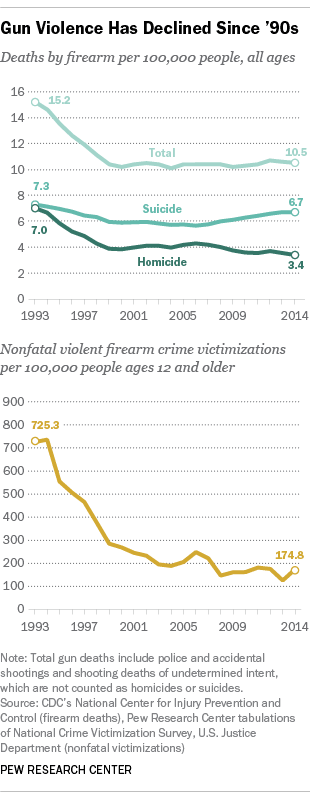
At the top of this article I mentioned suicides. If we look at the the number of firearm suicides, not just homicides, since 1990, we see that although the overall firearm death rate is down (from 15.2 to 10.6 per 100,000), and the firearm homicide rate has gone way down more than 50% (from 7.0 to 3.4) the suicide rate has remained relatively steady (and is actually on the rise).

Since most firearm deaths are suicides and since the rate is increasing, wouldn't it be more logical to focus on mental health and suicide prevention than on banning AR-15s? Even a small impact on the number of firearm suicides would save many more lives than an assault weapons ban could ever hope to save.

To find the rest of the posts in this series click here.

Friday, April 13, 2018

Thoughts on gun violence Part 4: Assault Weapons

One of the biggest most popular "solutions" to the gun violence problem is to ban "assault weapons." This is problematic on a number of levels.

First off, what is an "assault weapon?" It's whatever the people banning it want to say it is. The term "assault rifle" was a Nazi propaganda name for the MP44 machine pistol in World War II. It was basically a weapon that could fire lots of small, low power bullets. Machine guns had very limited effective range, and full power military rifles, while they had great range, had heavy ammunition. The idea of this weapon was to make the ammunition smaller and lighter so a soldier could carry more, and use it at intermediate distances, less than 300 yards.

The Russians came up with a version in 1947 called the AK-47 (for "Avtomát Kaláshnikova" or "Kalashnikov's machine gun"). In 1959 the US finally followed suit with the AR-15 (for "Armalite model 15" - Armalite was the manufacturer). The army renamed it the M16. In 1964 Armalite sold the name and design to Colt. Colt used the name to market a semi-automatic rifle (note, this was NOT a military rifle and NOT an assault rifle). After the patent ran out, the term "AR-15" began to refer to any rifle that looked similar to the Colt AR-15 and was compatible with some or most of its parts.

So an AR-15 is NOT an assault rifle. An assault rifle is defined as follows:
The U.S. Army defines assault rifles as "short, compact, selective-fire weapons that fire a cartridge intermediate in power between submachine gun and rifle cartridges." In a strict definition, a firearm must have at least the following characteristics to be considered an assault rifle:
Select fire means firing a burst of shots with one trigger pull - less than a machine gun but more than a semi-automatic, which shoots one round per trigger pull. Under the gun control act of 1930, revised in 1968 and 1986 American civilians cannot buy new assault weapons, or any kind of automatic or select fire rifle, and the antiques that are out there are strictly regulated, requiring special permission from the government and expensive fees and taxes.

So, assault rifles are already banned, but some people want to ban more weapons. Best way to do that is to create a new term "assault weapon" and define it to mean anything that they can get the public to confuse with a military weapon. The term "military style" is thrown around, which basically means things like being black, having plastic or aluminum parts instead of wood and steel, and "evil features" (not my term) such as a removable magazine, a barrel shroud, a pistol grip, a bayonet lug, a threaded barrel, an adjustable stock or a flash hider.

Why choose these features? Because they are the most common features found on the most popular guns made in the last 60 years. None of these features affects whether the gun is used by criminals or law abiding citizens. Rather, because people have been fed "Chitty Chitty Bang Bang" style propaganda in movies for so many years, they can be confused into thinking these rifles are somehow extra bad or extra deadly. Several politicians have issued statements to the effect that assault weapons can bring down commercial aircraft, can blow up rail roads, can turn a deer into hamburger and cook it, can fire 700 rounds in a minute, and other such nonsense.

What do I mean by Chitty Chitty Bang Bang propaganda? If you ever saw the movie Chitty Chitty Bang Bang you know it's about a magical car that can think, and turn into a boat, and even fly. We know that real cars can't do that, but if we never saw real cars, and only saw the movie, we might believe that that's what real cars did. So it is with guns. We see movies where people do impossible things with guns, and since most people don't have any real contact with guns they believe what is shown to them.

Now I've gone and talked so much about what an "assault weapon" is I will leave the discussion of them to the next post...

To find the rest of the posts in this series click here.