Showing posts with label Pope Jon Paul II. Show all posts

Saturday, August 29, 2020

A Biden truth

In my post on Presidential Impeccability I discussed can a Catholic vote for Donald Trump. Now I'd like to tackle the flip side, can a Catholic vote for Joe Biden. Just as in the case of Donald Trump, the answer hinges on the three "non-negoatiables" (please see the post linked to above for the whole discussion on non-negotiables.

Many of my friends who plan to vote for Joe Biden tell me they're actually voting for Kamala Harris, because they don't feel Joe Biden will be able to serve all (or maybe any) of his term. With that in mind I'm writing this as "can a Catholic vote for Joe Biden or Kamala Harris, and will be presenting material regarding both candidates.

So without further ado, let's go through the list:

On the dignity of human life from conception to natural death Joe Biden and Kamala Harris are not acceptable. Joe Biden has a 100% abortion support rating from Planned Parenthood and Naral. In 1992 Casey v. Planned Parenthood was struck down, upholding and affirming Roe v. Wade, due to a single vote, by Justice David Souter, whom Joe Biden had helped approve for SCOTUS. On the day this happened, fellow senator Warren Rudman describes meeting Joe as follows:

“At first, I didn’t see Joe; then I spotted him waving at me from far down the platform,” Rudman later recorded in his memoirs, Combat: Twelve Years in the U.S. Senate. “Joe had agonized over his vote for David, and I knew how thrilled he must be. We started running through the crowd toward each other, and when we met, we embraced, laughing and crying.”

An ecstatic Biden wept tears of joy, telling Rudman over and over: “You were right about him [Souter]! ... You were right!”

The two men were so jubilant, so giddy—practically dancing—that Rudman said onlookers thought they were crazy: “[B]ut we just kept laughing and yelling and hugging each other because sometimes, there are happy endings.”

Joe Biden opposes the Hyde amendment, which forbids using federal dollars to pay for abortions. He has promised to repeal the Mexico City policy, which forbids using federal money to support expansion of abortion in foreign countries. Biden is ok with China's "one child" policy of force abortion and sterilizations. Biden said he was "proud" to support a euthanasia bill.

Kamala Harris also has a 100% rating from Planned Parenthood and Naral. She opposes the Pain Capable Child Protection Act, which would limit late term abortions. Harris co-sponsored the “Women’s Health Protection Act,” which calls for abortion without limits until birth. Harris announced that as president she would require states that have a history of passing pro-life laws to seek preclearance from the Justice Department before they could enact any laws that would impact abortion on demand. Under her plan, any new pro-life laws would be considered unenforceable without preclearance from the Justice Department.

As Attorney General of California, when presented with video evidence that Planned Parenthood was committing crimes by illegally selling body parts, Harris colluded with Planned Parenthood to charge the reporters with crimes. That case is still ongoing, and Planned Parenthood still has not been investigated. 

On the dignity of marriage and family, Joe Biden has performed a same sex marriage. stuff
The protection of the right of parents to educate their children. 

As A.G. of California Kamala Harris refused to defend Proposition 8, the ballot initiative where Californian voters declared marriage to be between a man and a woman. A direct result of that was the legalization of same sex marriage in California.

On the protection of the right of parents to educate their children, Joe Biden wants to eliminate charter schools and eliminate funding sources for private schools. Kamala Harris has not voiced an opinion on the matter, although her overt bias against religious freedom and Catholics in particular make it unlikely she is a friend of private schools.

So... in pretty much every non-negotiable bot Biden and Harris are unacceptable candidates for a Catholic.

...and yet so many Catholics, even ones who claim to follow the Magisterium, plan to vote for them. Here's why I think, not only are they wrong, but they are putting their immortal souls in danger. The Catechism says:

1857 For a sin to be mortal, three conditions must together be met: "Mortal sin is sin whose object is grave matter and which is also committed with full knowledge and deliberate consent."

 So, the question is, is voting for Biden/Harris considered grave matter? Certainly being involved in abortion is (performing one, have one performed, paying for one, enabling another person to have one). But what about voting for abortion? In Evangelium Vitae, Pope John Paul II writes:

Therefore, by the authority which Christ conferred upon Peter and his Successors, in communion with the Bishops... I declare that direct abortion, that is, abortion willed as an end or as a means, always constitutes a grave moral disorder, since it is the deliberate killing of an innocent human being. This doctrine is based upon the natural law and upon the written Word of God, is transmitted by the Church's Tradition and taught by the ordinary and universal Magisterium. 
No circumstance, no purpose, no law whatsoever can ever make licit an act which is intrinsically illicit, since it is contrary to the Law of God which is written in every human heart, knowable by reason itself, and proclaimed by the Church. 
Abortion and euthanasia are thus crimes which no human law can claim to legitimize. There is no obligation in conscience to obey such laws; instead there is a grave and clear obligation to oppose them by conscientious objection...
In the case of an intrinsically unjust law, such as a law permitting abortion or euthanasia, it is therefore never licit to obey it, or to 'take part in a propaganda campaign in favour of such a law, or vote for it.
Please take the time to go read all of Evangelium Vitae. It is not a long read, and there is so much more there and the brief excerpts I have included above.
 
I would think that would settle things, but I have heard two arguments to "get around" this teaching and vote for Biden/Harris.

The first argument involves a note, that Cardinal Ratzinger wrote at the bottom of a fraternal letter to the US bishops:
 
A Catholic would be guilty of formal cooperation with evil, and so unworthy to present himself for Holy Communion, if he were to deliberately vote for a candidate precisely because of the candidate’s permissive stance on abortion or euthanasia. When a Catholic does not share the candidate’s stance in favor of abortion or euthanasia, but votes for that candidate for other reasons, it is considered remote material cooperation, which can be permitted in the presence of proportionate reasons.
 
From this some have concluded that as long as they say "I don't like abortion, but boy, that Joe Biden has a better plan for 'X' than Trump"  they can freely vote for whomever they please with a clean conscience. However, they ignore the phrase "can be permitted in the presence of proportionate reasons." What does "can be permitted" and what are proportionate reasons?
 
"Can be permitted" in the context of the letter means "still able to receive Holy Communion" - in other words, he's not saying it's fine, just that it's not a mortal sin.

As for proportionate means, what is "proportionate" to the brutal murder of close to a million completely innocent human lives every year? The answer is really only one thing - the brutal murder of even more completely innocent human lives. That is, if you were voting for a pro-abortion candidate because if you didn't a worse pro-abortion candidate would win. George Weigel explains it much better than I could in this article. The situation is not simple, but it is clearly not the case that this note is a "loophole" to let Catholics ignore 2,000 years of church teaching.

What about climate change? If the world ends in twelve years that kills more people than abortion. Could that be a proportionate reason? For this to be a proportionate reason, we would at least have to be as certain about those deaths as we are about the reality of abortion. That presupposes the following:
  • Biden/Harris alone have the power to change the earth's climate (e.g. the president has the power necessary to unilaterally change things).
  • Biden/Harris will change the climate as their top priority (e.g. it's not a campaign promise).
  • There is no other way to change the climate (e.g. we cannot work with any other lawmakers to address the problem)
There are problems right away with those assumptions. Although Biden has said he will eliminate fossil fuels by 2050 he has not proposed how that can be done (hint: it can't). Also, given that it was a priority for Obama/Biden for eight years, and there were no significant steps taken, it is unlikely that Biden/Harris can/will make such changes in half that time.
 
It is also unclear whether the methods the Democrats have proposed will even have a positive impact on climate. For instance, many of the initiatives put in place during the Obama/Biden administration, such as electric vehicles and solar power, simply moved environmentally dirty operations off to China and other countries with lax environmental laws and emissions exceptions in the Paris agreement. The current administrations' insistence on manufacturing things in the US has actually cleaned up some industries and reduced pollution, and Trump's Affordable Clean Energy Act is projected to reduce CO2 emissions by 35% by 2050. It is not at all a black and white issue.

In short, it is not a proportionate reason.

The second argument is that voting for a candidate is not the same as voting in favor of the policy. To me this seems a bit of a stretch because the only reason to vote for a candidate is because you want them to implement the policies you approve of. I suppose you could say "I don't care what the candidate's policies are, I just vote straight Democrat" but why vote Democrat unless you like the policies of the Democratic party (which are also extremely pro-abortion).

Another way to look at this is to use an analogy. Could a southerner in the  Civil Ware era say "I support Jefferson Davis and the south, but that's not related to supporting slavery?" As any honest person will tell you "A vote for Jeff Davis is a vote to preserve our southern institutions" (aka slavery). Likewise a vote for Biden is a vote to expand "women's healthcare" (aka abortion). When something is as integral to a person's platform as abortion is to Biden/Harris it is disingenuous to claim that your vote will not be an approval for them to go ahead with their support of abortion.
 
Ironically enough, this very same argument was used by Planned Parenthood to skirt the law against performing partial birth abortions.
 
“The federal abortion ban is a law, and laws are up to interpretation. So there are some people who interpret it as, it’s intent. So if I say on day one, ‘I do not intend to do this,’ what ultimately happens doesn’t matter.” (emphasis added)

For these reasons, I believe if you as a Catholic vote for Biden/Harris with full knowledge (knowing what has been discussed in this post) and consent, you are at risk of committing a mortal sin. I know people will excoriate me for pushing an agenda, and I am pushing an agenda, but my agenda is not political, it's spiritual. I don't want you, dear reader, to be in sin. Even if it is not mortal.
 
My other agenda is that we have, for the first time since 1973, a real chance to reduce the number of abortions in the US. Under president Trump abortions are already at the lowest level on over a decade. Having a president who promotes a pro-life cause, appoints pro-life judges, and allows pro-lifers to have a voice in government and the public square is already starting to change minds and hearts.

Sunday, November 8, 2009

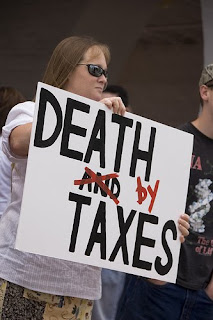
Grace and Taxes


I've been wanting to write this for a long time, but the words would not come. Recently, I read several pieces, by Matt Warner and others, that said what I wanted to say with enough eloquence to make me want to copy their work and add my own meager words to it.
I don't support the health care plan passed by the house recently. As you know, I've been attacked for being selfish and “un-Christian”, since how can you deny the right of the poor to have healthcare? Well, the easy response to give was the most obvious flaw in the healthcare plan; that it would support and fund abortion. In theory it does not, although I truly believe that the concessions made by the Stupak amendment will be watered down or removed entirely before the senate is done.

So I could continue to argue about abortion coverage, or euthanasia, or other life issues, but that is all probabilistic argument right now. Instead, there are the harder-to-explain (at least for me) reasons. For many of my friends the reason is money. They are already overtaxed, and with faltering economy, high unemployment, and depleted savings, the last thing they want is congress to spend another $1,000,000,000,000.00 (remember when the U.S. Deficit hit that number a few years back? Now we're talking about spending that much money in one bill in addition to the rest of the budget).

But although I don't want any more taxes, and I think spending money you don't have is ridiculous and criminally irresponsible I have reasons that bother me as much or even more. At the risk of sounding cryptic, I sum up my reason as “there is no grace in paying taxes”. Let me expound on that a bit.

Jesus explains in Matthew 25:34-40 (quoted from the New American Bible http://www.usccb.org/nab/bible/matthew/matthew25.htm)
Then the king will say to those on his right, 'Come, you who are blessed by my Father. Inherit the kingdom prepared for you from the foundation of the world.
For I was hungry and you gave me food, I was thirsty and you gave me drink, a stranger and you welcomed me,
naked and you clothed me, ill and you cared for me, in prison and you visited me.'
Then the righteous will answer him and say, 'Lord, when did we see you hungry and feed you, or thirsty and give you drink?
When did we see you a stranger and welcome you, or naked and clothe you?
When did we see you ill or in prison, and visit you?'
And the king will say to them in reply, 'Amen, I say to you, whatever you did for one of these least brothers of mine, you did for me.'
From this passage and others we get the seven “corporal works of mercy” which are:
  • Feed the hungry
  • Give drink to the thirsty
  • Clothe the naked
  • Shelter the homeless
  • Visit the sick
  • Visit those in prison
  • To bury the dead
One can clearly extend the “visit the sick” to mean “care for the sick” and conclude “we must pass healthcare legislation!” But just because legislation says it will care for the sick, does that make it an appropriate remedy?

What I mean by “no grace in paying taxes” is this. When I perform corporal works of mercy I m doing God's work. When I pay my taxes, am I doing God's work? I have no choice in the matter, so I am not choosing to do these things. On the contrary, anyone who does not pay taxes is fined and in the case of healthcare thrown in prison as well.

Likewise, since money is fungible I can't even claim that my money went to help the uninsured. In Luke 20:22-25 Jesus is posed a question about taxes
Is it lawful for us to pay tribute to Caesar or not?"
Recognizing their craftiness he said to them,
"Show me a denarius; whose image and name does it bear?" They replied, "Caesar's."
So he said to them, "Then repay to Caesar what belongs to Caesar and to God what belongs to God."
I've heard that used to defend paying taxes for healthcare legislation. But I'll note two interesting things. First off, Jesus does not say it is good to pay taxes or even right to pay taxes. He says it is lawful to pay taxes. In other words, you are not sinning when you pay taxes. But the cool thing is that there is always another level (usually many) in every Gospel story.

Jesus tells the scribes and chief priests that they should pay Caesar the coin, which belongs to Caesar because it has Caesar's image on it. He also tells them to repay to God what belongs to God. What do you suppose we have that is made in the image of God? Ourselves. That giving of ourselves is not part of paying the tax, but in addition to it. We can't sit back, pay taxes once a year and say “I have fulfilled a moral obligation.” we personally need to feed the hungry, give drink to the thirsty, clothe the naked, shelter the homeless, visit the sick and imprisoned and bury the dead. Forcing others (and being forced ourselves) to do it is not in keeping with the Gospel.

Matthew Warner has expressed it succinctly and far more beautifully than I can in his post at Fallible Blogma “A Tired Democracy”:
There will always be people in need. We must help them – not empower some ultimately corrupt government to do so on our behalf. Jesus commanded us to love/feed/help/clothe others. Nowhere does he teach that we are to force others to do so on our behalf. And I would challenge every Christian out there who continues to attack “rich” people they’ve never met, and those of you who demand and empower our government to take from one to give to another, to search your heart as to whether Jesus would ever do that? Or to find one place where Jesus calls us to do that?
Lastly, there is subsidiarity. I had internalized the definition of this word many years ago, without having the word to describe it. I only came across it in the Catechism of the Catholic Church recently, and it has been used often by the bishops in discussions of the current healthcare legislation. The CCC has this to say (http://www.vatican.va/archive/catechism/p3s1c2a1.htm#I):
1883 Socialization also presents dangers. Excessive intervention by the state can threaten personal freedom and initiative. The teaching of the Church has elaborated the principle of subsidiarity, according to which "a community of a higher order should not interfere in the internal life of a community of a lower order, depriving the latter of its functions, but rather should support it in case of need and help to co- ordinate its activity with the activities of the rest of society, always with a view to the common good."
1885 The principle of subsidiarity is opposed to all forms of collectivism. It sets limits for state intervention. It aims at harmonizing the relationships between individuals and societies. It tends toward the establishment of true international order.
So we have to examine the question, “is healthcare reform necessary on a national level?” I would argue that some forms of healthcare reform are appropriate on a national level. Things like interstate competition between insurance companies, and availability of generic treatments from foreign sources should be addressed at a national level. Sadly, none of these issues is addressed by the current health care bill.
Bishop James Van Johnson had this to say in “Skinning the Health Care Cat"  (which I also quoted in “Why I Can't Support the Health Care Bill Part II” and which I will repeat part of here - color added to text by me):
“One might legitimately ask if giving a large, inefficient, but powerful bureaucracy like the federal government control of health care is a wise move. For one, this runs counter to the well-known principle of subsidiarity, so prominent in Catholic social teaching: “a community of a higher order should not interfere in the internal life of a community of a lower order, depriving the latter of its functions, but rather should support it in case of need and help to coordinate its activity with the activities of the rest of society, always with a view to the common good."

How much of a role the government should have is a matter of prudential judgment. However, there are ethical dimensions to this question. Certainly, it has a role to play, but that does not necessarily mean that it should be the sole provider of health care. The government can act to remove abuses, and to regulate the health care industry so that the markets efficiently serve all the people.
Archbishop Joseph Naumann and Bishop Robert Finn have this to say in “Principles of Catholic Social Teaching and Health Care Reform” (text colored by me - I didn't have the audacity to color any of the popes' text - it is all relevant):
The writings of recent Popes have warned that the neglect of subsidiarity can lead to an excessive centralization of human services, which in turn leads to excessive costs, and loss of personal responsibility and quality of care.
Pope John Paul II wrote:
“By intervening directly and depriving society of its responsibility, the Social Assistance State leads to a loss of human energies and an inordinate increase of public agencies, which are dominated more by bureaucratic ways of thinking than by concern for serving their clients, and which are accompanied by an enormous increase in spending.” (Pope John Paul II, Centesimus Annus #48)
And Pope Benedict writes:
“The State which would provide everything, absorbing everything into itself, would ultimately become a mere bureaucracy incapable of guaranteeing the very thing which the suffering person—every person—needs: namely, loving personal concern. We do not need a State which regulates and controls everything, but a State which, in accordance with the principle of subsidiarity, generously acknowledges and supports initiatives arising from the different social forces and combines spontaneity with closeness to those in need. … In the end, the claim that just social structures would make works of charity superfluous masks a materialist conception of man: the mistaken notion that man can live ‘by bread alone’ (Mt 4:4; cf. Dt 8:3)—a conviction that demeans man and ultimately disregards all that is specifically human.” (Pope Benedict XVI, Deus Caritas Est #28)
While subsidiarity is vital to the structure of justice, we can see from what the Popes say that it rests on a more fundamental principal, the unchanging dignity of the person. The belief in the innate value of human life and the transcendent dignity of the human person must be the primordial driving force of reform efforts...
It is very clear that, respectful of this principle, we must find some way to provide a safety net for people in need without diminishing personal responsibility or creating an inordinately bureaucratic structure which will be vulnerable to financial abuse, be crippling to our national economy, and remove the sense of humanity from the work of healing and helping the sick.
The Church clearly advocates authentic reform which addresses this obligation, while respecting the fundamental dignity of persons and not undermining the stability of future generations.
Both of us in our family histories have had experiences that make us keenly aware of the necessity for society to provide a safety net to families who suffer catastrophic losses. Yet, these safety nets are not intended to create permanent dependency for individuals or families upon the State, but rather to provide them with the opportunity to regain control of their own lives and their own destiny...
For example, legislation that excludes legal immigrants from receiving health care benefits violates the principle of solidarity, is unjust and is not prudent. In evaluating health care reform proposals perhaps we ought to ask ourselves whether the poor would have access to the kind and quality of health care that you and I would deem necessary for our families. Is there a way by which the poor, too, can assume more responsibility for their own health care decisions in such manner as reflects their innate human dignity and is protective of their physical and spiritual well being?
So, even with the Stupak amendment I oppose the current health care legislation. Aside from the fact that I believe it will bankrupt our economy and do more harm to citizens and good, I have these objections. It still contains at least the capacity (and arguably the reality) of life issue abuses. It is unjust. It violates principles of subsidiarity. And it supplants good works with corrupt buearocracy.

Friday, May 15, 2009

Still Crazy After All These Years

In January of 1610 Galileo discovered his eponymous moons of Jupiter and confirmed empirically that Ptolemy was wrong. Nearly 400 years later I read an article by Dr. Stephen Hawking that caused me to complain so vociferously my friends urged me to start a blog (presumably so they could just ignore my RSS feed instead of me personally). I'd like to comment on the article, then the incident.

The Article

Dr. Hawking, for those of you who have been living in a black hole, is one of the worlds' most famous cosmologists. He is a theoretical physicist who holds the position of Lucasian Professor of Mathematics at Cambridge University (but that's another blog post). His work on black holes (hence the earlier pun) is the work on black holes. In other words, smart guy.

However, smart does not (alas) make one right, and theoretical physics does not give one expertise in areas of history. Hawking misremembers, misinterprets, and misinforms. I can't repeat the entire article here, but the gist of it has been promulgated by him in various forms for years, as in this story from 2006.

The implication is that science and the Catholic Church are irreconcilably at odds today, and presumably the reader is supposed to come away thinking "well, I have to give up one or the other, and since science clearly works..." Since we're scientists, let's look at the "facts" Hawking uses to support his hypothesis.

Hawking claims that Pope John Paul II told scientists they should not study the beginning of the universe because it was the work of God. Just reading this red flags go up for me.
  1. But...all creation is the work of God, so why would the pope single out that one event as "unstudiable"?
  2. The Church (with a few exceptions) has always supported scientific inquiry, from Copernicus, who's theory it was that Galileo published to Monsignor George Lemaitre, who first proposed the Big Bang theory in 1927 (but that's another blog post).
  3. Why would the Vatican host a conference on cosmology for scientists if it didn't want scientists to study cosmology?
Apparently Dr. Hawking's memory is faulty, nor did he nor any of the publications in which this quote has been printed over the last 3 years think to use google. I did, and in minutes was reading the complete text of Pope John Paul II's address to the conference at which Hawking claims the statement was made. It can be found here. For those as lazy as I here is an excerpt:
Cosmogony and cosmology have always aroused great interest among peoples and religions. The Bible itself speaks to us of the origin of the universe and its make-up, not in order to provide us with a scientific treatise, but in order to state the correct relationships of man with God and with the universe. Sacred Scripture wishes simply to declare that the world was created by God, and in order to teach this truth it expresses itself in the terms of the cosmology in use at the time of the writer. The Sacred Book likewise wishes to tell men that the world was not created as the seat of the gods, as was taught by other cosmogonies and cosmologies, but was rather created for the service of man and the glory of God. Any other teaching about the origin and make-up of the universe is alien to the intentions of the Bible, which does not wish to teach how heaven was made but how one goes to heaven.

Any scientific hypothesis on the origin of the world, such as the hypothesis of a primitive atom from which derived the whole of the physical universe, leaves open the problem concerning the universe's beginning. Science cannot of itself solve this question: there is needed that human knowledge that rises above physics and astrophysics and which is called metaphysics; there is needed above all the knowledge that comes from God's revelation. Thirty years ago, on 22 November 1951, my predecessor Pope Pius XII, speaking about the problem of the origin of the universe at the Study Week on the subject of microseisms organized by the Pontifical Academy of Sciences, expressed himself as follows: "In vain would one expect a reply from the sciences of nature, which on the contrary frankly declare that they find themselves faced by an insoluble enigma. It is equally certain that the human mind versed in philosophical meditation penetrates the problem more deeply. One cannot deny that a mind which is enlightened and enriched by modern scientific knowledge and which calmly considers this problem is led to break the circle of matter which is totally independent and autonomous - as being either uncreated or having created itself - and to rise to a creating Mind. With the same clear and critical gaze with which it examines and judges the facts, it discerns and recognizes there the work of creative Omnipotence, whose strength raised up by the powerful fiat uttered billions of years ago by the creating Mind, has spread through the universe, calling into existence, in a gesture of generous love, matter teeming with energy".
Reading the Pope's speech in its entirety it is clear that there is no such injunction against studying the origins of the universe. The Pope clearly states that science is involved in the physics of creation, while religion concerns itself with the metaphysics of creation. There is no conflict.

Hawking goes on to say that he feared he would be the subject of an inquisition like Galileo because of the paper he was working on. According to Hawking's recount of the events, Galileo was given papal permission to publish his book, but when the Church realized Galileo's ideas becoming popular they forced him to recant and suppressed his work. So let's look at the events of Galileo's "incident" through the eyes of history, not opinion.

The Incident

Now that I've built up your expectations, let me start by saying I'm not going to rehash the whole thing here. There are a number of sources who have done a much better job than I could of presenting the situation. I do insist that you read sources who have actually studied the documents involved rather than articles by people who have heard things third and fourth hand and are spouting their own opinions. My first introduction to the issue was from the book "Brother Astronomer: Adventures of a Vatican Scientist" by Guy Consolmagno, but there are other accounts that have been well researched.

It seems to me that while Galileo was put under house arrest, it was not because of his support for Copernicus but rather his mocking of the Pope. To quote Wikipedia (not that it is a definitive source, but it is one of the better on-line sources):
The book, Dialogue Concerning the Two Chief World Systems, was published in 1632, with formal authorization from the Inquisition and papal permission. Pope Urban VIII personally asked Galileo to give arguments for and against heliocentrism in the book, and to be careful not to advocate heliocentrism. He made another request, that his own views on the matter be included in Galileo's book. Only the latter of those requests was fulfilled by Galileo. Whether unknowingly or deliberately, Simplicio, the defender of the Aristotelian Geocentric view in Dialogue Concerning the Two Chief World Systems, was often caught in his own errors and sometimes came across as a fool. This fact made Dialogue Concerning the Two Chief World Systems appear as an advocacy book; an attack on Aristotelian geocentrism and defense of the Copernican theory. To add insult to injury, Galileo put the words of Pope Urban VIII into the mouth of Simplicio
So, Galileo was given papal permission to print his book provided he change it to include included the words of Pope Urban VIII, who had a contrary opinion to Galileo. He changed the book, but put the words of the pope in the mouth of the simpleton.

Now, Hawking says he fears for the inquisition because of his paper. But perhaps he should be more worried about putting his words into the mouth of Pope John Paul II.

The Truth

What else has the Pope said on the roles of religion and science, and about Galileo?

From "Address of Pope John Paul II to the Participants on the Vatican Conference on Cosmology" 6 July 1985 (4 years after the one Hawking complained about):
Please know that your diligent work, especially in the field of astrophysics, together with your ecclesial dedication, bears splendid witness to the Church’s profound interest in the world of science and particularly in the men and women engaged in scientific research.

I warmly greet the observational astronomers and the theorists in gravitational physics and cosmology who have accepted the invitation to take part in this important meeting. It is a joy to welcome you today, together with the members of your families.

Through the natural sciences, and cosmology in particular, we have become much more aware of our true physical position within the universe, within physical reality - in space and in time. We are struck very forcibly by our smallness and apparent insignificance, and even more by our vulnerability in such a vast and seemingly hostile environment. Yet this universe of ours, this galaxy in which our sun is situated and this planet on which we live, is our home. And all of it in some way or other serves to support us, nourish us, fascinate us, inspire us, taking us out of ourselves and forcing us to look far beyond the limits of our unaided vision. What we discover through our study of nature and of the universe in all its immensity and rich variety serves on the one hand to emphasize our fragile condition and our littleness, and on the other hand to manifest clearly our greatness and superiority in the midst of all creation - the profoundly exalted position we enjoy in being able to search, to imagine and to discover so much. We are made in the image and likeness of God. Thus, we are capable of knowing and understanding more and more about the universe and all that it contains. We can reach out and grasp its inner workings and designs, plumbing its depths with questioning reverence and with awestruck imagination.
There is, of course, more to the address. From "The Vatican's Turn to Recant":
In 1979, a year after he became Pope, John Paul II signaled that he wanted the Galileo case set right by giving a speech at the Pontifical Academy of Sciences at which he declared in typically elliptical Vatican language that "theologians, scholars, and historians, animated by a spirit of sincere collaboration, will study the Galileo case more deeply." In case anyone missed the point about the Pope's desire for a reconciliation of science and religion, John Paul II choose as the date for this speech the centenary anniversary of Einstein's birth.

In October 1992, Cardinal Paul Poupard presented the Pope with the findings of the Galileo study commission, which declared, "From the Galileo case we can draw a lesson which is applicable today in analogous cases which arise in our times and which may arise in the future. It often happens that, beyond two partial points of view which are in contrast, there exists a wider view of things which embraces both and integrates them." By Vatican standards, this rotund language was an apology. The Pope responded by saying that Galileo's realizations about the sun and earth must have been divinely inspired: "Galileo sensed in his scientific research the presence of the Creator who, stirring in the depths of his spirit, stimulated him, anticipating and assisting his intuitions." Through its 1992 ceremony, the church finally lifted its edict of Inquisition against Galileo, who went to his grave a devout Catholic, despite the church's treatment of him.
In fact the Vatican is erecting a statue of Galileo.
So, where does that leave the Church's position on Science? In 2005 Pope Benedict XVI addressed yet another conference with the words
"There is no opposition between faith's understanding of creation and the evidence of the empirical sciences," he said, quoting from Popes Pius XII and John Paul II.
He also cited Galileo, whom, he said "saw nature as a book whose author is God in the same way that Scripture has God as its author."
Where does that leave scientists' position on the Church? In 2008 Pope Benedict XVI was "uninvited" to speak at La Sapienza at the request of its physics department, because he had quoted a document on the Galileo trial (with which he did not agree). See The Curt Jester's blog post on that subject for more details.

Who's running an Inquisition now?