Showing posts with label Science. Show all posts

Thursday, August 24, 2017

Eclipse Report

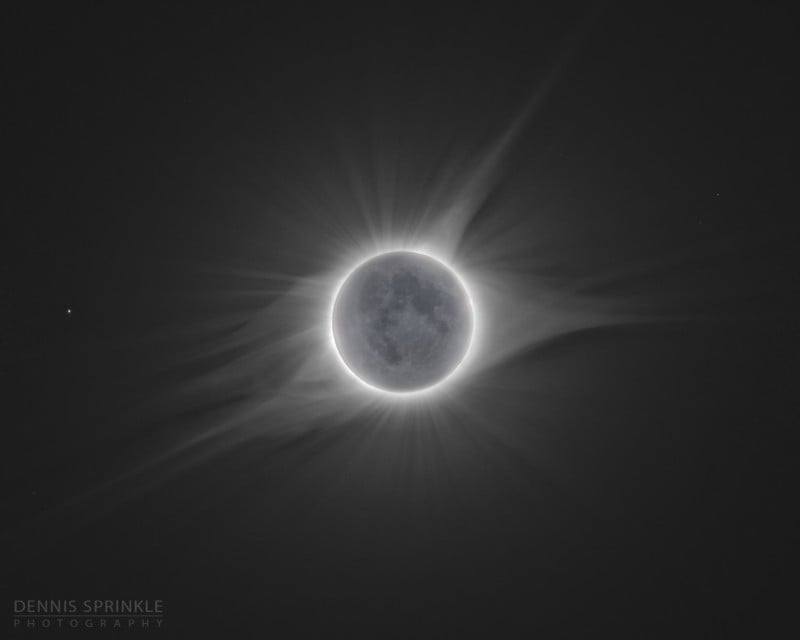
Not my picture
Unless you live under a rock you know that 8-21-17 was the "Great American Eclipse." This is my story of the eclipse. It started back in 2007 when I first began planning to see the eclipse. I wasn't sure where it would be visible at that point, but given my age and circumstances, I determined I wanted to see at least one total solar eclipse, and this would be it.

The Best Laid Plans...

Our first plans, once we knew from where totality would be visible, was to go to Jackson, WY. We had been to Grand Teton several years back, and started and ended the trip in Jackson. As you can see, it is comfortably in the zone of totality (between the red lines).
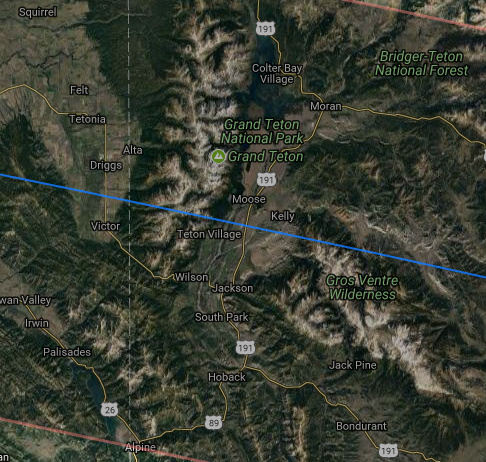

It's also a beautiful place to bee, as is Grand Teton National Park. If you haven't been, highly recommended.

But you can't book a vacation seven years in advance, and so I waited... too long. About a year in advance I went to book a place in/near Jackson, only to find out that you could not rent an outhouse - everything was booked! Perhaps it was for the best, as I'm sure it would have been more crowded than where we ended up.

Where did we end up? I chose two places, Nashville TN, and Salem, OR, and quickly booked hotels in both places. Then booked a third in Albany, OR, thinking it's just as close to totality as Salem, but a shorter drive up from the Bay area, where we could visit my wife's aunt. Also, we could not find a flight into/out of Portland on the days we wanted to travel.

We decided on OR instead of TN based on a web site that had the probability of cloud cover for any day of the year for a given area. Albany, OR had a 25% chance of cloud cover, vs. a 40% chance for TN.

Over the next couple of months we booked the rest of our hotels, flights etc. We spent time in the Bay area, then drove up the coast through redwoods to Albany, OR, then after the eclipse went down through Lassen Volcanic Park and back to catch the flight home. When I canceled our TN reservation, rooms (which were going for $200) were now going for over $1000!

Equipment

This is what I used to observe the eclipse. I am not saying it was the best, but it served my needs well.

For my eyeballs

I got a 10 pack of eclipse glasses on Amazon. I made sure they were "certified" ISO compliant glasses. No sense in messing with your eyes. Although only four of us were going I wanted 10 in case we lost/damaged some, or to share with other eclipse viewers who didn't have a pair.

As it turned out, the hotel we were staying at, the Comfort Inn and Suites in Albany OR, had a welcome packet with eclipse glasses for their guests. Nice place, and nice people. I would stay there again.

Telescope

As you may know I am an amateur telescope maker, and so I had grandiose plans of building a small scope for this eclipse, or maybe converting my 6" scope into a collapsible model but of course time and tide... to view the sun you don't need a lot of aperture, and I decided to purchase a Celestron 70mm travelscope. I used camelcamelcamel and waited until it was on sale for about $50.

The scope comes with its own backpack, tripod, finder scope, image erector prism, and 20mm and 10mm eyepieces.

The scope itself is decent. Very good image, with surprisingly little color aberration. Everything is plastic, but decently made. With a 13mm Nagler (I have an older one, and it is HEAVY) you could see the flex in the OTA, but even so the image was good. I like this scope! The backpack was nice, for carrying the scope on the air plane (I would not trust checking it).

The image erector is so-so, but you need it, or an extension tube, to reach focus on the eyepieces I was using. Also, because the sun was at 40 degrees elevation at the tie of the eclipse, it was nice having the prism so the eyepiece was facing up (a 90 degree prism would have been even better).

Speaking of which, the eyepieces were OK, but I decided to use one of my better quality telescope eyepieces. I opted for a no-name 20mm plossl I've had for years, and my 13mm Nagler. Images through the Nagler are as awesome as can be, but there is very little eye relief for people with glasses.

The tripod that comes with the scope is garbage. I opted to use a camera tripod I picked up at Costco for $50 a few years ago, during a photo emergency. That tripod is flimsy as well, but is way more sturdy than the one that came with the scope.

Likewise, the finder scope is garbage. I removed the optics, and put a piece of plastic cut from a Chinese food takeout container (with a dot in the center) in place of the objective, and a sheet of paper with a small circle drawn on it in place of the eyepiece. I adjusted it so that when the scope was pointed at the sun, the dot of light from the objective fell on the paper in the circle. Crude but effective.

Note to Celestron - I would have been willing to pay more for a sturdier scope without the tripod, and with a cheap red dot finder scope in place of the crappy one you provided.

I purchased a commercial solar filter for the scope, since I didn't want to be bothered building my own filter. However, when I tried it out the sun was painfully bright. I stopped the filter down from 70mm to about 25mm, which was better, but I wasn't sure I trusted it.

The filter claimed to be made from Baader planetarium filter material, even had the Baader paperwork in the box. I wondered if they had used the photographic-only version of the film, or if it was counterfeit. Sure enough, about a week before we were to leave, I get an email from Amazon saying that they were unable to verify that the filter was safe, and that they would refund my money.

Fortunately I have made many solar filters over the years, and I had what was left of a roll of Baader filter material. I merely had to make the filter.

Camera

I have a Canon T2i camera, with a 55-250mm lens. While I can get good photos of the sun, it's kind of small. At 250mm the sun is roughly 250/120 = 2.1mm on the camera's sensor. The T2i has an APS-C sized sensor, which is 22.2x14.8mm, so the sun fills only 1/7th of the frame. Ideally I'd like the image to be at least 1/3 of the sensor size, or 5mm, which would require a 600mm lens. 600mm lenses, are expensive.

I could mount the camera on the telescope with a T-ring adapter, but that would leave me with no visual scope, and my primary purpose was to SEE the eclipse, not to photograph it.

I though about renting a lens. I know people who did, with great success, but I was leery of having to lug the rented lens all over. I would also have to make a solar filter for a lens that wouldn't be useful afterwards. Additionally, since I would be gone over a week, and I would need to get the lens a week or two early to practice, I would be paying $225, for a one-time use thing.

Instead I picked up a 2x tele-xtender for $99 that makes the 250mm lens into a 500m lens - at the cost of doubling the focal ratio (which I didn't care about) and losing the ability to auto-focus (which I cared about, but not enough to want to shell out $1000 for a dedicated lens). I had good success with it in the backyard, although focusing on the sun was difficult. How I long for the days of split image focusers on cameras!

For the camera, I had to make my own filter. Commercial ones were not only expensive, but impossible to come by. Attaching a homemade filter to the lens was a bit tricky. In the end I bought  a cheap screw on rubber lens hood and made the filter to fit that.

The two solar filters fit in a Chinese food takeout container, which fit in the telescope's backpack, along with the scope, finder, eclipse glasses and tripod. The rest of the optics went in my camera bag.

Needless to say, with a long focal length lens you need a good tripod. Luckily I have an old Slik tripod from my Dad that is very stable. Speaking of which, the tripod was actually broken, and so old I couldn't find any information on it. I took a picture of the damage and model number, which I emailed to Slik, asking how I could get it repaired. In about an hour or two they sent me an email saying I could order the parts from them (the email had a parts list and diagram of the tripod) and a video on how to repair it. The parts cost only $7, and arrived in a few days, and I was up and running! Very good customer service!

The Experience!

Driving up, the weather report looked good but we had heard of wild fires with thick smoke. We heard one place not too far away had to be evacuated! As we went up, at times the sun was barely visible through the smoke! Fortunately, the area where we were going was in between fires.


I had read about what an eclipse is like. I had seen photos. NONE of that prepared me for the real thing. We arrived at the hotel the evening before. One man was standing in the triangle of grass by the road setting up a camera. Turned out he spoke very little English, and didn't know where the eclipse would be in the sky.

Fortunately I had gotten this great app, TPE (The Photographer's Ephemeris) for my phone. It shows all sorts of data bout sun, moon, light and shadow. According to it, First contact would occur at about 105 degrees azimuth and 20 degrees elevation, and totality would be at 120/30. Using the app and the compass and level apps on my phone I was able to walk the property and find the best place to set up the next morning. I was in a spot where everything would be visible, but I could sit in the shade of a tree.

The next morning the hotel was full of people. There were three general categories. A group from France, of mostly older people, Asian tourists, and "crunchy geeks". This last category drove up from California in their Priuses, wore birkenstocks, floppy hats and Tee shirts with slogans like "Surely not EVERYBODY was Kung Fu Fighting" and "It's not rocket science - oh wait, it is!" and other geeky things.

Oddly enough all of those people sat by the road in the hot sun, while a small group of us sat in the back parking lot where it was not crowded at all. The small group consisted of American families, mostly from northern California. There was a young couple who sat with their glasses on and held hands the whole time; parents with their two small children, who played with a "robot dog" the whole time; an older couple who just had sheets of dark plastic they held over their faces... You get the picture. I was the only person who had a scope you could look through, and at times there was a line to look through my scope. I was glad I brought it. Here was my setup.


First contact was cool through the scope but you couldn't tell anything was going on. It wasn't until the sun was about 80% covered that things began to get weird. First off, every little speck of light through the trees turned into an upside down image of the eclipse.


Next, the light began to be...odd. It seemed to me that everything had a greenish tint. I think it's because everything is getting dark, and my brain wants it to be reddish sunset, but in fact the light is daylight colored. It's very hard to explain, and a picture doesn't show anything wrong.

I spoke to some people who viewed the eclipse from a valley and they said they could see the shadow approaching them over the mountains. That must have been cool. A few seconds before totality, there are ripples of light on the ground. My son said he saw them, but I forgot to look - I was too busy watching the sun go dark.

I was able to see "Bailey's Beads" and "The Diamond Ring" for a fraction of a second. Then I was entranced by the sight of a black spot where the sun should be, surrounded by a glowing corona. I unscrewed the filter on the camera and hastily focused, but the results were kind of lackluster...


The sky was dark - not as black as at night, but you could see brighter stars and planets. It was about two minutes long, but it seemed like seconds before it all happened rapidly in reverse and I had to screw the solar filters back on.

Aftermath

After the eclipse we were told there would be horrendous traffic, so we were prepared to stay until the next day. However, that would have meant driving eleven hours to the airport the next day, so we decided, after seeing that Route 5 was moving pretty well, to chance it. It would only be four and a half hours to Redding, and we would get to see Lassen Volcanic National Park, which I really wanted to do.

So we got in the car, and... I will tell you traffic moved pretty well... until there was construction and a lane was gone... and then an accident... and then rubbernecking for another accident... and then...

We got creative with ways to get off the highway and find it again. However, roads were closed or detoured for construction that Google Maps really wanted us to use. Suffice it to say that 9 hours later we rolled into our hotel.

Lessons

I learned a few lessons from the experience:
  • If you have a chance, go see a total eclipse! I don't think I would go cross country just to see the eclipse, but as part of a vacation it was nice.
  • Book early, and often! Although some of the people we were with had booked the hotel the night before, it is less stressful to book ahead. Do your research on weather and traffic!
  • Ditch the camera! Honestly the pictures I got were not very good, and every second I spent staring through a camera was one I did not spend enjoying the eclipse.
  • Bring a telescope. The travelscope was just the right size,  and the 20mm eyepiece pretty much ideal. I suppose I could have gotten by with the tripod it came with, but the simple modifications I made were useful.
  • Practice. Work out any equipment bugs by viewing the sun at home ahead of time. I had worked out all the settings on my camera, but even for visual observing it is useful to practice. For instance, my wife discovered the glass didn't work well with her prescription glasses - it was easier for her to hold the eclipse glasses in her had an inch in front of her glasses.
  • Stay! In retrospect we should have stayed put until the next day when (hopefully) the traffic was less. In our case, our schedule didn't allow us to add a day to the vacation, but if I could I would have done it differently.

Thursday, January 21, 2016

The Revealing Science of God

This is in response to a recent discussion on Facebook wherein an atheist claimed religion was wrong because it did not follow the scientific method. Specifically it does not admit that it might be wrong.

I wonder if this person would admit that he is wrong about religion, because he is - about Christianity, at least. Yes, there are religions that are entirely "this is the way things are because Religion™" but Christianity is not one of them. Here's what I mean:

1. Christianity is based on empirical evidence. Unlike every other religion, the basis of Christianity is a series of events that are public and were historically documented. Jesus performed miracles and taught to thousands of people. He was executed publicly and after his Resurrection continued his public ministry to thousands.

These events are documented not jus tin the Bible, but by secular historians and witnesses. We have said evidence that these events actually took place - not just by the number of people who witnessed them, but by the fact that those witness would undergo torture and death rather than rescind their testimony.


2. Christianity is based on logic. After Christ's Ascension some of the best minds over the next few hundred years teased out the logical implications of those events. The principle of "Occam's Razor" is sometimes thrown about by atheists to imply that the explanation of religion is overly complex. Yet they fail to remember that William of Ockham was a Catholic Franciscan Friar.

Attempts to dismiss Christianity based on logic arguments fall down themselves based on logical contradictions. Because it is evidence based, Christianity is the most easily falsifiable religion. And yet if you deny the basis of Christianity you come up with a problem elsewhere that requires extraordinary faith to solve.

For instance, suppose we believe the Resurrection didn't happen. Then what happened to Christ's body? Do you propose that a small group of frightened persecuted Jews were able to overcome Roman guards? All the Romans had to do to discredit the Christians was to produce the body of the man they had killed.

OK, maybe Christ didn't really die. Now you suppose that Roman executioners whose job it was to ensure the condemned were really dead, couldn't do so. And that putting a spear through someone's heart was not enough to kill him. Or, for that matter, that someone who had undergone scourging or the other tortures to which Jesus was publicly subjected to could, in three days, heal enough to walk long distance and teach people?

Every explanation leads to more difficulties than it addresses. By the application of Occam's razor Christianity is the simplest hypothesis that explains observed facts.

3. Science does not admit to "being wrong" either. The main objection by the original poster was that religion insists that everything it says is right, while Science™admits that it could be wrong about anything. However, this is not quite true. Yes, science admits that its explanation for phenomena could be incomplete, but it does not admit that basic scientific truths are "wrong" or changeable.

For instance, Newton formulated that force = mass times acceleration (F = ma).  It will never be the case that scientists say "oh by the way, force mass and acceleration? Not related, it turns out." We may refine the formula to be more precise under more conditions (think relativity) but those refinements better reduce to the underlying equation in the ideal case.

There are also things in Christianity that we just don't know, things that we have theories about, and things that are "settled science" (like the existence of God).


Friday, February 13, 2015

Who watches the watches?

This week a colleague left work as part of a "force reduction" at my company. In her parting email she wrote "Feels like destiny, but more of a happenstance, my atheist self won't let me get away with destiny talk."

Which reminded me of a story. Last week I was at the filming of Jeff Cavins' new Bible study series "Unlocking the Mystery of the Bible." While I was there, Jeff told this story.
An atheist and a Christian were walking down the beach one afternoon. They came upon a Rolex watch in the sand, still ticking, and displaying the correct time. 
"I wonder how that watch got there?" said the atheist. 
"I know" replied the Christian. "The raw materials of the watch were on the sea bed, and billions of years of wind and water, and the energy of tectonic movements and volcanism caused those materials to be formed into a watch that happened to have the right time and be placed on the beach." 
"Ha ha" said the atheist drily, "Do you honestly expect me to believe that?" 
The Christian replied "I only claimed that about a watch - you believe that about everything in the universe."
My atheist colleague, and the atheist in the joke recognize that there is no "intention" or "meaning" to the subject at hand, but they fail to recognize the consequences of their beliefs. Because although in limited cases order can arise out of randomness, intention, or meaning does not. Ever.


So, as the video says, if all we have is the material world, how do you account for things like "will" "intention" and "meaning? According to the video, it all comes from "quantum mechanics." And as we all know, quantum mechanics is "random." And "random means there is no reason, no meaning, no intention discernible (presumably because there is none).

That means that, according to the atheist world view, the Christian's assertions in the story are correct. The watch got there by an accidental chance of nature. If the atheist is right, the people who mined the ore, smelted it, designed the watch, made the parts of the watch, assembled it, sold it, bought it, and left it on the beach were all acting according to the demanding dance of quantum particles in their brains, and through no "will" of their own.

If followed to its logical conclusion, the denial of God means that there is no will, no meaning, no love nor hate, no good nor evil, no thought, no logic, etc. How many of you who don't believe in God are willing to assert all that your belief implies, and to live as if that were true? Or are you really hypocrites who want to believe something, but don't have the conviction of your beliefs.

Even the "agnostic atheists" who say that they will accept the possibility of a god, but they personally don't see any evidence, and therefore do not believe - they have to answer this same question. Do you really see no evidence that you can choose something, that you can love someone, that something can be good or evil, or have any kind of meaning?

...and please note that I am not relying on the Bible or Christianity or even religion to make this argument - this is based on science. If there is nothing but science, nothing but the material world, this is the only possible conclusion.

Saturday, December 27, 2014

Neil deGrass Tyson is better than satanists

Read the latest bruhaha about Neil deGrasse Tyson? Apparently he's still a jerk. But sorry, I am not outraged. Yes, he is posting secular messages about Christmas, but what did you expect an atheist to post at Christmas?

Yes, it would be nice if he posted something nice, but let's get real - the guy has made quite a big name for himself by being an insensitive jerk. Let's look at some:
QUESTION: This year, what do the world's Jews and Muslims call December 25th? ANSWER: Thursday!
Actually Christians called it Thursday as well, and from what I've read, Muslims do not call it Thursday, but al-Khamīs (fifth day). But who really cares?
On this day long ago, a child was born who, by age 30 would transform the world. Happy Birthday Isaac Newton b. Dec 25, 1642
True (as far as I know - I don't care enough about it to look up Isaac Newton's birthday to confirm). And at least he had the courtesy not to add "CE" to the date.
Merry Christmas to all. A Pagan holiday (BC) becomes a Religious holiday (AD) which becomes a Shopping holiday (USA).
Well, historically inaccurate, but I can sympathize with his dismay of the commercialization of Christmas. But as I said I am not bothered in the least with his posts. I am, however, bothered by the satanist display at the Michigan Capitol. Tyson's posts, while not Christian, were not anti-Christian.

The satanist "snaketivity scene" can't be interpreted as anything but anti-Chrsitian. There is no satanic holiday that it commemorates. According to my understanding their major holidays are Walpurgisnacht and Halloween. So a big display on a non-holiday can only be construed as a mockery of the holiday it's opposing. In fact the very name "snaketivity" indicates it is a mockery of a nativity scene.

So yes, the fact that a blatant hate message must be "tolerated" by Christians who are not allowed their own expression without calls of bigotry is hypocritical and, well, intolerant.

Sunday, June 9, 2013

Rouding out my weekend

I was browsing around the interwebs yesterday when I came across this cool video about the definition of the kilogram. I was aware of the attempt to make a very round sphere of silicon, but didn't know the history behind it. Vive Lavoisier! [Well, requiescant in pace Lavoisier.] As Mr. Spock would say "fascinating."

I also didn't know why they used silicon. Silicon is the second most abundant element in the Earth's crust (after oxygen), and yet was unknown until the 19th century because it bonds so tightly in chemical compounds. It seems silicon was used for this because we know so much about its crystal structure.


Of course, after watching the video I went to find out more and found this article by the lab that produced the spheres. Interesting, btu I must take offense at their claim:
CSIRO’s Australian Centre for Precision Optics is the only place in the world capable of fabricating round objects with the accuracy required for the Avogadro Project.
and
The best sphere the ACPO team has ever made had a total out-of-roundness of 35 nanometres. That is, the diameter varies by an average of only 35 millionths of a millimetre, making it probably the roundest object in the world.
Now, as an amateur telescope maker I have to say that's good, but not great. I have made spheres accurate to 5nm, so these are certainly not the roundest objects in the world. Here is a graph of a mirror made by a friend of mine showing the surface error in nm (I'm assuming he doesn't mind me using an image displaying his optical fabrication prowess).

This is a 20" diameter paraboloid that's accurate to within 10nm. Makes the silicon sphere look bumpy! On the other hand, the mirrors we make are not complete spheres, but segments of spheres (or often paraboloids, as the optical design calls for different shapes). I don't think it would be any harder to make a complete sphere than a segment, but I can't say for sure.

I was also curious as to how they tested a convex sphere to that accuracy. It is easy to test a concave sphere, much harder to test a convex sphere. The video indicates that they used a laser spinning around the sphere. But that test would depend on the accuracy of the bearing the laser spun on. I guess that would have to be averaged out over many tests.

Either way, this is a fascinating topic, that bears witness to the beauty and complexity of even the simplest thing in nature.

Saturday, April 20, 2013

Design and purpose

Shows design and purpose


Has no design or purpose, completely chance

Wednesday, October 17, 2012

Recording the end of an era

A friend showed me this cool time lapse video of the space shuttle moving across LA. The only thing that would have been cooler is if it included the trip across the country as well.

The moment is bittersweet, however, as it reminds me of how far we have fallen in our nation's goals. When I was a lad, the space age had begun and we were a nation eager to do more.

Things like rechargeable battery technology, hybrid cars, velcro, LEDs, artificial limbs, scratch-proof glasses, freeze dried foods, firefighting gear, water purification, solar panels, and literally hundreds of other inventions all came from the exploration of space. It is estimated that every $1 spent on space exploration resulted in $7 entering the economy through new jobs and new technologies.

Today, as a nation we have completely lost our manned space program. We have to rely on other countries to do it for us. The technologies developed have changed very little in 50 years, and again other countries have surpassed us in many of those areas. We have become a nation of followers instead of leaders. Instead of our national focus being on education and peaceful exploration, it is on free birth control and the erosion of our liberties.

If I keep talking I'll wind up crying. Why don't I just show the video already?


Watching it reminds me of an event that took place over 50 years ago, described in the book The Perfect Machine, when the 200" pyrex mirror for the Hale telescope was moved across country from the Corning glass works in NY to Pasadena, CA, and later to the Mt. Paloma observatory.

According to the Mt. Palomar web site, in 1936
The mirror blank, with only a rough flat front surface, is shipped across the country on a special train from New York to Pasadena, always traveling slower than 25 miles per hour.
The telescope project has captured the public imagination, and thousands of people line the train tracks to watch this special cargo. Guards are posted around the mirror during overnight stops to prevent any damage to the disk. The trip takes sixteen days.

The mirror was ground and polished over the next 11 years, removing about 5 tons of glass to perfect it's shape. In 1947
The 200-inch mirror is transported from Pasadena to Palomar on November 18-19, 1947. The 40 ton cargo requires three diesel tractors to push it up the mountain. Despite a storm, which nearly aborts the transport, the 125 mile trip is completed in 32 hours.
After removing the concrete disk (now located outside the dome) that was used to test the support structure, engineers install the mirror. Initial imaging results are promising but not ideal. It takes two years to finish polishing, aligning, and adjusting the mirror. 
I wish I had been there to see that move!

Monday, September 24, 2012

Monday Joke

The recent screeds by Bill Nye, Gary Trudeau and others about how belief in the Biblical creation narratives is harmful to children reminded me of a joke.

Many years from now, when scientist discover how to create life, they decide science has disproved God, so they select a scientist to go up to the top of a mountain to break the news to him.

The scientist shakes his fist in the air and shouts "God, we don't need you and we don't want you. We are masters of the universe. We can create life from dirt, just as you did."

"Show me" says God, with an amused tone in his voice.

The scientist begins scarping dirt together with his hands.

"No no" says God "get your own dirt."

Tuesday, July 3, 2012

Upside Down

Every wonder how your phone knows to rotate the screen? Here's a quick video that I found interesting. Enjoy.


Sunday, June 3, 2012

How to View the Tranist of Venus

If you've been following science news at all, you know there is a transit of Venus on Tuesday. The image to the right is one I took of the last transit of Venus. This is what a transit looks like. Kinda cool.

Having been asked by a couple of folks I thought I'd make a post on how to safely view the transit of Venus which is scheduled for around 22:20 UTC (a little after 6 PM EDT). First off, what not to do. Do not look at the sun with the naked eye, with sunglasses, through binoculars or a telescope that does not have an approved solar filter. Even if you think you can look safely, you can damage your eyes. Likewise, if you have a telescope with a solar filter that fits on the eyepiece end of the scope, throw it out (the filter). They are dangerous. I know someone blind in one eye using one of them.

If you don't have an approved solar filter that attaches to the front of your telescope or binoculars, the best way to view is by projection. This can be used with most small telescopes or binoculars, and is safe. I'm adding a disclaimer that the sun is hot, and when you project it through your binoculars or telescope the inside can get hot. Be careful or you can damage your binoculars, telescope or eyepiece. For that reason I suggest you use cheap stuff, not your million dollar binoculars, for this.

If you have a scope larger than 6 inches or so in diameter consider putting a cardboard mask with a 4" or smaller hole in it over the front. Many scopes come with end caps that have a smaller cap over a 2-3" hole, which you can also use. The problem is that with 8" or more of aperture it is too easy to accidentally burn something (like the inside of the scope). Put a cover over the finer scope, since that can destroy itself by focusing sunlight inside it. If you don't have a lens cap for your finder scope, put a sock or something over it. Put your lowest power eyepiece in the scope, and crank the focuser all the way out. If your scope where the tube can be rotated, turn it so the eyepiece faces down toward the ground.

If you have binoculars, put the front lens cap on one side - we're only going to be using one half of the binoculars, and if you don't over the other lens the sunlight it focuses can seriously damage the binoculars (or you). Focus the binoculars on the closest thing they will focus on.

Next, get a piece of white paper. hold it about a foot from the eyepiece, and aim the binoculars or telescope at the sun. You can't use a finder scope to do this, so the best way to do it is to look at the shadow of the scope or binoculars and make it as small and round as possible. you may have to move around a little to find the sun.
Turn it until shadow is in a line...
Now tilt up/down...
Perfect!
Once you do, try to keep it centered in the field. When it is half out of view, the other half of the sun is heating up the inside of your scope, and can do damage. If you're going to walk away for a minute, cover the front of the scope or move it 90 degrees away from the sun so it doesn't accidentally burn the inside of the scope.

Play with the distance to the paper and the focuser until you get a well focused, decently sized image. If you want, you can make a viewing box to increase the contrast of the image.

To do that, take a cardboard box (mine is something like 8"x16"x30") and cut a piece out of one end. Leave the corners, as it will help the box keep its shape.
Make a projection screen out of white paper or foam board and place it on the end opposite the cut out. You can use the cut out to measure the size of the projection screen.
Line the other 3 sides of the box with something black (I used a tri-fold presentation board made from black foam board). Put it together as shown.
The black sides of the box will keep out stray light, so the projected image of the sun is easier to see.

Enjoy, and if you do see the transit, please post a comment and tell me about it.

Saturday, June 2, 2012

Good Design

Some things are just so well designed you nkow that a lot of thought and effort has gone into the planning. For instance, each time I start my car, the radio resets the volume so that it doesn't blare at me, even though the volume might have been left up high when it was turned off. And even then, the sound doesn't just come on, but it fades in at just the right rate so it doesn't sound jumpy, nor does it creep up on me.

All around me are things which are well designed. My TiVo, for instance, has three fast forward speeds. When going through a commercial break at 64x normal speed, I can still be assured that when I see my show come back I can hit the PLAY button and the TiVo jumps backward most times to just the right place where I intended to stop, instead of at the point where I actually hit the button. It's pretty obvious that a lot of thought and effort went into the design.

When we see an object we can often tell instantly about its design by how well it fits the function for which it was intended. For instance, look at a car.


Regardless of the particulars, you can tell it's a sophisticated piece of design. The intricate sleek shape, the way the doors fit nicely, the materials used all indicate the efforts of a team of skilled designers. But a machine doesn't have to be so complicated to show the level of thought that went into its design. Even something as simple as a hammer speaks volumes about the design. Different kinds of hammers are optimized for different tasks, and believe me, an extra inch in length or a few degrees of curvature in the claw of a hammer can make the difference between efficiency and frustration.


When we designed our deck I was surprised to learn about the level of thought that went into steps. The height, width, depth, and overhang all require thought. Or look at something like Stonehenge. Even though it is just a pile of rocks, nobody would mistake it for just a pile of rocks, because it clearly shows the intent of the designers.


But perhaps I'm being a little prejudiced in talking about human accomplishments. Even a bird's next is clearly distinguishable form a random pile of sticks.


Which is why it always boggles my mind that people can look at the following and claim that there's no evidence of any design or designer.


Sunday, March 11, 2012

It's not a tumor!

The other day at the dinner table my son asked about tumors. Specifically, what's the difference between a tumor and normal tissue growth. I explained that in a tumor, the growth is uncontrolled and the cells are undifferentiated and uncoordinated. If you have a tumor on your kidney, for instance, it is not more kidney cells that are growing. In fact, if you did organize the cells, and grew a third kidney, it would not be a tumor, but an organ. There is a biological difference between normal tissue and a tumor.

Which meshed nicely with an online discussion I had recently about fetal development. Some pro-choice folks put the embryo in the category of a tumor, and that is completely inaccurate, scientifically. They don't consider the baby to be human until it has developed the things that they consider make a being human - a heart, brain, fingers, etc. The discussion involved when does a human being begin to develop these things. Some pro-lifers gloss over the issue and say "heart beat - 21 days" and be done with it, but the reality is more complex. Just as a baby doesn't magically form from a mass of amorphous tissue as it exits the uterus, so there is no "bright line" where you can say there is a heart, or brain. Those organs develop over time.

So I began looking up information on fetal development. The information I'm about to present is available from embryology texts, although much of it is echoed here https://en.wikipedia.org/wiki/Embryogenesis and http://biology.kenyon.edu/courses/biol114/Chap13/Chapter_13B.html timetables can be found at http://www.nrlc.org/abortion/facts/fetaldevelopment.html and http://faculty.washington.edu/chudler/dev.html

Although most of us don't think about the development of specific features before the fetal stage, the zygote does indeed, have marked cellular differentiation. In fact, at fertilization the egg itself becomes asymmetric and the first two cells of the zygote are distinct, one going on to form ectoderm and mesoderm, the other to form the endoderm. So if we're using differentiation and organization as the criteria, then is it clear that from fertilization on these traits are present. The first cell of you was not a tumor.

Some people want to use something like the brain as a criteria for humanity. First off, note that the human species is quite accurately defined, scientifically. Any attempt to require more than membership in the species is an attempt to exclude some members of the species from attaining their legal rights. The question to be asked is "why is not being a human being sufficient to be treated as one?"

But let's talk about the brain anyway. How much brain is enough brain? The embryo begins forming the nervous system with the primitive streak at about 14-16 days. The nervous system has formed visibly at 21 days. The human brain isn't fully formed until about 21 years after birth. So those who argue on brain function don't really have a leg to stand on.

Some will argue on the basis of brain function, not brain development, but aside from the obvious "why" question, how much brain function is "enough" and how does one measure it?

Alberto Giubilini and Francesca Minerva, in their paper entitled “After-birth abortion: why should the baby live?” argue that a human has no rights until he can be "self aware". What does it mean to be self aware, and how can we know if someone is? Should we apply intelligence tests to everyone each day, and those who score below a certain rank lose the right to live?

The point I'm trying to make is that there is no "bright line" in development from conception to birth, or after. Any point we choose, whether it be the beginning of brain development at 21 days heartbeat at 22 days, neural waves detectable with current technology at 42 days, "awareness" at two years after birth etc. is merely an arbitrary point on a continuum. Attempts to justify abortion (or in the last case infanticide) based on development is an attempt to say "I can kill these humans but not those humans." Why should we accept killing humans at all?

Sunday, January 29, 2012

Ice Age (not the movie)

It's been over a year since I wrote Stupid Letters, The Global Warming Scam, and Science? I Think Not! As you may recall, I've noted that the best predictor of Earth's climate is not CO2, but solar activity.

So, since a noble squirrel friend pointed me towards this article in the UK Daily Mail, I thought I'd make a quick post about it.
The supposed ‘consensus’ on man-made global warming is facing an inconvenient challenge after the release of new temperature data showing the planet has not warmed for the past 15 years.

The figures suggest that we could even be heading for a mini ice age to rival the 70-year temperature drop that saw frost fairs held on the Thames in the 17th Century.

Based on readings from more than 30,000 measuring stations, the data was issued last week without fanfare by the Met Office and the University of East Anglia Climatic Research Unit. It confirms that the rising trend in world temperatures ended in 1997.
of course, this can't be right, can it?
Yet, in its paper, the Met Office claimed that the consequences now would be negligible – because the impact of the sun on climate is far less than man-made carbon dioxide. Although the sun’s output is likely to decrease until 2100, ‘This would only cause a reduction in global temperatures of 0.08C.’ Peter Stott, one of the authors, said: ‘Our findings suggest a reduction of solar activity to levels not seen in hundreds of years would be insufficient to offset the dominant influence of greenhouse gases.’

These findings are fiercely disputed by other solar experts.

‘World temperatures may end up a lot cooler than now for 50 years or more,’ said Henrik Svensmark, director of the Center for Sun-Climate Research at Denmark’s National Space Institute. ‘It will take a long battle to convince some climate scientists that the sun is important. It may well be that the sun is going to demonstrate this on its own, without the need for their help.’

He pointed out that, in claiming the effect of the solar minimum would be small, the Met Office was relying on the same computer models that are being undermined by the current pause in global-warming.
So we have the battle of astronomers and climate scientists using actual data, against climate "scientists" who cling to their computer simulations. The points I think are worth learning from all of the brouhaha are:
  1. The Earth's climate is constantly changing. Global warming Climate Change is not something new.
  2. Despite our desire to have everything about us, not everything is about us.
That's not to say that I don't think we should respect the environment or conserve energy (I do), but simply that alarmist propaganda is just that - a manufactured crisis in order to create an opportunity to push an ideological agenda.

Thursday, January 19, 2012

Life

It seems, according to a Mr. Zimmer, that NASA has wasted $2.5 billion, because scientists can't define life. Last November, NASA launched Curiousity, a rover designed to look for life on Mars. However, according to the article:
When NASA says it wants to find out if Mars was ever suitable for life, they use a very circumscribed version of the word. They are looking for signs of liquid water, which all living things on Earth need. They are looking for organic carbon, which life on Earth produces and, in some cases, can feed on to survive. In other words, they’re looking on Mars for the sorts of conditions that support life on Earth.

But there’s no good reason to assume that all life has to be like the life we’re familiar with. In 2007, a board of scientists appointed by the National Academies of Science decided they couldn’t rule out the possibility that life might be able to exist without water or carbon. If such weird life on Mars exists, Curiosity will probably miss it.
Of course, the claim of the article, that scientists can't define life, is absurd. The standard definition of life used by biologists is in no way restricted to carbon-based water loving life forms. But we do have to use some criteria for looking for life, and in fact, I think looking for places that we think are like Earth is a good strategy. Certainly we stand a greater chance of finding life if we look in places like those where we know life exists.

But what the article fails to mention is how we could look for the kinds of life proposed. If we make no assumptions about the chemistry used or the conditions required, we literally have to look at everything, everywhere. That is not something we have the technology to do. It's easy to criticize someone else's methodology as being too narrow, but harder to come up with an alternative approach.

A few years ago I attended a lecture by Freeman Dyson. He has an interesting idea, which I like to explain this way. There's an old joke about a drunk looking for his keys under a street lamp. A passerby stops and helps him look and finally asks if he's sure the keys are here. The drunk replies that he thinks he lost the keys in the alley. Then why have we been searching here? Because the light is better, says the drunk.

Dyson's idea is not to look for life where we think it is, but to look where it is easy to look. Hunters find animals in the dark by shining a light out into the darkness, and when the animals look back, observing the reflections from their eyes. The method is called "pit lamping" and it is illegal in most places.

According to Dyson we could search for life in the solar system without ever leaving Earth. We simply (OK, it's not that simple, but easier than sending robotic probes) illuminate parts of the solar system with powerful beams of light and using ground-based telescopes observe the reflection. By analyzing the spectrum of the returning light we could look for chlorophyll or other chemicals associated with photosynthesis. This assumes the life gets its energy from light, which is not necessarily true either, but as I said some assumptions have to be made or the search is too hard.

Dyson gives a similar lecture in the TED talk entitled Let's look for life in the outer solar system.

At about 3:50 into the video he begins speaking about the search for life. It sounds like a viable way to search, for someone who had the desire and funds. Is it a likely way to find life? Dyson himself admits it is not, but it covers a large amount of real estate very cheaply.

Tuesday, December 27, 2011

Belief Part 3 - Ending the Beginning

In Part 2 of this series I talked about Thomas Aquinas' "five proofs" for the existence of God. There are a couple of things to add before we go onto other arguments. In the last post, Einstein, Hubble, and Lemaître demolished Fre Hoyle's steady state model of the universe, but there are two other logical replies to the "uncaused cause" argument that are commonly given to avoid a universe with a beginning.

Multiverse

The multiverse hypothesis holds that the universe exists because all things that can exist exist, everything that can happen happens. This not only appears to get around the origin of the universe, but of any need for any sort of deity, belief, moral stricture, etc. Everything is random. There are a couple of problems with this, both logically and scientifically. First off, the logician might say "OK, why does everything happen, rather than nothing" which is really Thomas' "why is there something rather than nothing" question repackaged. You still have to posit and uncaused cause, only now it's for everything, not just the universe.

Secondly, if everything that can happen happens, why doesn't it happen in our universe? Why don't the laws of physics suddenly change? Why doesn't the laptop I'm writing on turn into a grapefruit? How can we ever believe in a scientific principle, when those principles can change at any given time?

"Oh, but Mike, they can't!" you reply. Why not? Show me, if everything that can happen happens, how you can ever posit that something can't happen in this universe. Perhaps this is the universe where gravity reverses every 13.7 billion years, which happens to be tomorrow? If you believe in an ordered universe, then you have to suppose that not everything that can happen happens, and if you're going to put some restrictions on it, occam's razor would suggest that rather than limiting it to only those universes you like, using a large number of restrictions, you might as well go the whole way and say there's only the one, and it's the one we're in and this is how it works.

Besides, evidentially we can only say there is one universe, despite attempts y some to wish that every bit of unexplained data "leaks" in from another universe. Once again occam's razor suggests an argument from evidence is stronger than one based on wishing.

Bouncing Universe

The second argument against the beginning of the universe is the "cyclical universe" or "bouncing universe" hypothesis. This is the one Stephen Hawkings resorts to in his latest book. In this we suppose that the universe either repeats itself forever, or changes each time (which is basically a serialized version of the multiverse). Either way, there are still two flaws with this hypothesis. First off, in the sense that this is a serialized multiverse, it is subject to all the counterarguments above. Secondly, the second law of thermodynamics makes it impossible. Like a ball that bounces a bit lower each time, our bouncing universe is subject to entropy and will run down.

In fact, what Hawking conveniently left out of his book were all the scientific arguments against the bouncing universe. One of these is the Borde-Vilenkin-Guth Theorem (BVG). In 2003 Borde Vilenkin and Guth came up with a proof that says that given the laws of physics, any universe or system of universes (whether they be bouncing or multiverses) where the universe has a Hubble expansion rate greater than 0, must have a beginning.

In fact, this proof is vastly applicable to just about any model universe or multiverse that could be produce our universe. Alexander Vilenkin put it this way in 2006:

We made no assumptions about the material content of the universe. We did not even assume that gravity is described by Einstein’s equations. So, if Einstein’s gravity requires some modification, our conclusion will still hold. The only assumption that we made was that the expansion rate of the universe never gets below some nonzero value, no matter how small. This assumption should certainly be satisfied in the inflating false vacuum. The conclusion is that past-eternal inflation without a beginning is impossible.

Kind of hard to hold to eliminate a "first cause" at this point, no?

I think this puts the last nail in the coffin for the arguments against Thomas' five proofs (or at least all the ones I know - do you know any others?). I realize that at this point all I have addressed is "does the universe have a creator". I have not shown that that creator is an "invisible friend in the sky" or even that the creator is an intelligence, only that a creator exists. It's going to take a long time to get to that.

In the meantime, I would like to highly recommend Robert Spitzer's book New Proofs for the Existence of God: Contributions of Contemporary Physics and Philosophy. The physics section will give and awful lot to chew on, such as the above.

Friday, December 16, 2011

Belief Part 2: Doubting Thomas

This is the second post in a series on the existence of God. I've read and heard a lot from atheists of late, and frankly I have not found one who is willing to consider any possibility outside of their belief system (and of course, they deny that they ave a belief system when clearly they believe so strongly that God can't exist they will forgo logic and reason to keep that faith). My purpose in writing this series is to explore what we can know about God through reason, and if it is "unreasonable an unscientific" to believe in God, or, as I contend it is more unreasonable and unscientific to believe He doesn't exist.

Of course, no discussion of the existence of God is complete without referring to St. Thomas Aquinas' "five proofs". His "five proofs" are the basis of many arguments from theists and atheists alike. Thomas wrote these almost 800 years ago, and so you'd think there was nothing new to say, but modern science has added some new observations. Let's look at them.

First Mover - since objects at rest remain at rest unless acted upon by an outside force (e.g. Newton's laws), the observation that objects are in motion implies an outside force to set them in motion. One can appeal to forces like gravity and explosions for things to "move by themselves" but each requires potential energy to have been put in the system (e.g. for a star to form via gravity it must have been formed from particles which were already separate against gravitational forces).

Philosophically speaking the "movement" can be something other than physical. I've couched this in terms of physics because it is the easiest for me to discuss. I never personally found this argument to be compelling because it seems to me that if the universe were always in motion, that motion could be simply transferred, as one billiard ball will set another in motion, and the second can come back and hit the first. It wasn't until college physics that I learned that this position doesn't work. More on this after I discuss the other two.

First Cause - things cannot cause themselves. Therefore, all that exists must have been caused to exist by something. To posit that the universe caused itself presents the dilemma refuted by Stephen Hawking in A Brief History of Time and Space, which he terms "turtles all the way down". Oddly, Hawking uses the argument that the universe caused itself in his latest book The Grand Design. I guess he only accepts logic when it supports his conclusions.

At first I found this argument unconvincing, because I had read books on quantum mechanics about how particles spontaneously came into existence in a vacuum. However, a vacuum isn't really nothing. As a physicist will tell you, there is space-time, and that is required for quantum laws to allow particles to come into existence. What makes space-time? According to Hawking gravity, a warping of space-time, creates space-time, which creates it. Beginning to sound like turtles?

The other argument I find used involves hypotheses like multiverses. I'll be covering these in a later post, but to whet your appetites, the scientific principle of Occam's Razor suggest that relying on something imagined to replace something you claim is imagined does not improve your position. Plus the multiverse is just another layer of "turtles". It does not address a first cause.

Contingency - all things in the observable universe are contingent on something else for their existence. Therefore the thing which brought them into existence existed without them. There must be something which exists outside of the universe.

Fr. Robert Barron, in his excellent PBS series "Catholicism" explains this in terms of a cloud on a Summer's day. The cloud exists because of the humidity, pressure and temperature of the air. Those conditions are caused by things like sunlight hitting the Earth, and the very composition of the atmosphere is influences by things like the respiration of plants. Those in turn depend on things like gravity, nuclear forces, evolution etc. Ultimately there comes a point where we get to the universe itself. To posit the universe is not contingent is not supported by any evidence, and in fact all evidence points to all things being contingent. Therefore it is reasonable to assume that there exists something outside the universe.

Of course, Fr. Barron is much more eloquent than I am. After all, he's a TV star. However, I think you get the point. And saying that the thing outside the universe is more universes (AKA the multiverse again) is falling back to the "turtle" argument.

The main thing about all three of these arguments is that they involve "the buck stops here". When people refer to these and say "turtles" they obviously haven't read or didn't understand these proofs. They are persuasive because to avoid them you have to postulate "turtles". You might ask "well, why can't the universe have gone on forever?" That was a position held by astronomer Fred Hoyle.

Fred Hoyle was a brilliant astronomer, cosmologist, and the man who coined the phrase "Big Bang" to disparage the theory proposed by Georges Lemaître. Monsignor Lemaître was a priest and professor of physics at the Catholic University of Louvain, who proposed that the universe was expanding from a single point, which he called the "primeval atom". Hoyle supported a theory called "steady state" which claimed that the universe was eternal and constantly renewed itself.

A detailed discussion of what went on would take more than this post, but suffice it to say Einstein's general theory of relativity coupled with Edwin Hubble's observational evidence, put the final nail in the coffin of the steady state model. Hoyle later recanted his steady state claims, and even left atheism and became a theist because of science. I'll cover his story in more detail in a future post as well, because his change of heart was due to science, not revelation.

That someone can today insist that the universe always existed, or regenerates itself simply does not fit with observed scientific evidence or with established laws of physics. For instance, the second law of thermodynamics states that entropy never decreases. Any claim that the universe exists forever or regenerates has to assume a magical way that this and other laws of physics can be suspended. I see no reason to think that this sort of imaginary process is any more likely than God.

The last two proofs of Thomas are different.

Greatest Being - some things are greater than other things. Therefore, there must be a being of perfect greatness, from which all other things derive their greatness.

This argument is based on ancient Greek philosophy, but I find it unconvincing, since there is an assumption that such a perfect being exists as proof that one exists. One argument in favor is that existence is greater than non-existence, so if the greatest being did not exist, it would not be the greatest being (and therefore the greatest being must exist).

I don't hold with the assumption that if we can imagine a being it must exist. Ironically, that is an argument used by some atheists to support the "all possible timelines" model of explaining the universe. They assume that the reason the universe exists is because everything that can exist must exist. By that argument, of course, God must exist (unless He can't exist, which is something they will argue without evidence).

Intelligent Designer - purpose requires intent. Since there are things in the universe that work towards a purpose, they must have been an intelligence who directed them towards that purpose.

This is another argument I find weak, because it supposes that the universe has a purpose without offering evidence to that end. I believe there is evidence to that end, which I will explore in a future post, but without that evidence, it would seem to be a circular argument - it relies upon intelligence behind the universe to prove intelligence behind the universe.

Your mileage may vary. I know some find one proof more compelling than another. However, I have yet to see a refutation of the first three proofs that does not rely upon a logical or scientific contradiction, or just plain wishing. If you know of one, I would be more than happy to hear it.

There are dozens more proofs to be covered and lots of counterarguments to debunk, so this series is for now open ended. The next post will begin to cover a different class of proofs.

Sunday, March 27, 2011

Fukushima in perspective

Worried about the claims that radiation levels are thousands or even millions of times normal at the Fukushima reactors? Do pray for the people of Japan (and not just those living by the reactors, but all those affected by the disaster), but don't be too alarmist. This XKCD chart shows the numbers in perspective. Click on the chart for a version you can actually read.

Thursday, December 2, 2010

New Life

I just couldn't not blog about NASA's announcement today.
NASA has discovered a new life form, a bacteria called GFAJ-1 that is unlike anything currently living in planet Earth. It's capable of using arsenic to build its DNA, RNA, proteins, and cell membranes. This changes everything.
I agree that this is a big deal. We have up to now assumed that DNA had to be made up of the same elements all the time. These bacteria use arsenic (yes, that arsenic, the poison) in place of phosphorous in their DNA. The article goes on...

NASA's geobiologist Pamela Conrad thinks that the discovery is huge and "phenomenal," comparing it to the Star Trek episode in which the Enterprise crew finds Horta, a silicon-based alien life form that can't be detected with tricorders because it wasn't carbon-based. It's like saying that we may be looking for new life in the wrong places with the wrong methods. Indeed, NASA tweeted that this discovery "will change how we search for life elsewhere in the Universe."
Here's where I get lost. The Horta, as we all know, replaced carbon with silicon. Now, carbon is a big deal. Just about every molecule in living organisms relies on carbon in some way, to the extent that the term organic chemistry is used to describe chemistry of carbon compounds. Replacing phosphorous is not in my mind as big a deal, because while phosphorous is essential to life, the amount of it in a living organism is relatively small and the organism using it would still be recognizable (as opposed to the Horta, which didn't even register on the tricorder as living). Not that this isn't still a big deal, but whereas I would think the Horta would have a completely different life process, I could see this arsenic-based DNA behaving very similarly to the rest of Earth's life.

But why arsenic, of all things? In 1868 Dmittri Mendeleev began writing a chemistry textbook. One of his ideas was to arrange the known elements (60 at the time) in order of increasing weight. This had been done before, but Mendeleev noticed that when they were written in tabular form, some elements in the same columns had similar properties. This had been noticed before also, but what Mendeleev did, and which required a leap of faith, was to force similar elements into the "correct" columns based on their properties, leaving empty places in the table. Mendeleev claimed that the holes in the table were as yet undiscovered elements, and by looking at the patterns in the table he was able to predict the properties of these unknown elements.

For instance, there was a gap under aluminum in Mendeleev's table, which he called "eka-aluminum" (eka is a Sanskrit word meaning "one more than"). From the patterns in the table he predicted that eka-aluminum would be discovered to have certain properties. He predicted it's atomic weight would be around 68, its density would be around 5.9 and it would be a metal with a low melting point. In 1875, eka-aluminum was in fact discovered by French chemist Paul-Émile Lecoq de Boisbaudran who named it gallium (and there's a fascinating story in the naming of gallium as well). Gallium's atomic weight is 69.9, density 5.93, and it's melting point at 30.1° C (which means it can melt in your hand)!

At any rate, the answer to "why arsenic" is because arsenic is right below phosphorous in the periodic table (you could call it "eka-phosphorous"). In that sense it is chemically very similar to phosphorous, and can form similar bonds with similar other elements to make similar molecules that have similar properties.

As for naming gallium, at the time, the discoverer of an element got to name the element. Gallium's discoverer, who was French, claimed to have named it for France, since the Latin name for France is Gaul. However, his name was Paul-Émile Lecoq de Boisbaudran, and Lecoq means "the cock", which in Latin is Gallus. So perhaps he was naming the element for himself, rather than his country. We'll never know.

Monday, November 1, 2010

Human Extinction!!!

Nothing like an eye catching headline to catch eyes, and um, sell books. Rebecca Costa writes a blurb in the Huffington Post to push her new book, "The Watchman's Rattle." Yawn. Anyway, I perused her list of 12 things we must do Now! to prevent human extinction. Here's my take on her 12 things:
  1. We need clean air, potable water, and untainted nutrition

    Duh! How would I implement this? Reduce regulation and let the market handle it. As I showed in my earlier post on CF light bulbs, they are bad for the environment. Why do we use them? Government regulations and incentives. "The pill" is polluting our water supplies, and destroying our wildlife and fish. And our government wants to make it free?

  2. Follow facts, not beliefs

    More excellent advice. On many fronts today, from abortion to global warming, people believe what the government or media tell us instead of finding out the facts. Sadly, finding the facts is not always easy, because lots of people claim things as fact that are actually beliefs. Things like "if abortion weren't legal tens of thousands of women would die each year." That is, in fact, a false statement made up by NARAL co-founder Dr. Bernard Nathanson. Dr. Nathanson confesses in his book, Aborting America "I knew the figures were totally false, and I suppose the others did too if they stopped to think of it. But in the ‘morality’ of our revolution, it was a useful [Nathanson’s italics] figure, widely accepted, so why go out of our way to correct it with honest statistics?"

  3. Try more solutions simultaneouly

    A capital idea! Educational problems? Stop legislating "solutions" at the federal level and let states and even local communities try different solutions. Likewise economic issues, social issues, etc. The Catholic church proposes the concept of subsidiarity which states that nothing should be done by a larger and more complex organization which can be done by a smaller and simpler organization. The Catechism states:
    1883 Socialization also presents dangers. Excessive intervention by the state can threaten personal freedom and initiative. The teaching of the Church has elaborated the principle of subsidiarity, according to which "a community of a higher order should not interfere in the internal life of a community of a lower order, depriving the latter of its functions, but rather should support it in case of need and help to co- ordinate its activity with the activities of the rest of society, always with a view to the common good."
  4. Incentives for the good/disincentives for the bad

    Interesting idea, if we acknowledge the existence of "good" and "bad". Too often I hear the people proposing government incentives for [their favorite thing] also tell me that "good" and "bad" are relative, and therefore up to the individual. Well, then how can you say you are promoting the good? You are only trying to force your opinion on others.

    What "good" are we trying to promote by overturning the definition of marriage? By overturning the definition of human life? By persecuting or forbidding religious expression?

  5. Make brain fitness mandatory

    I though that was called education and it was mandatory.

  6. Give NASA another mission

    Here I agree 100%. From an economic viewpoint, every $1 spent on NASA results in $7 funneled into the US economy. Form a "green" standpoint, most of the energy saving or alternate energy technology we have today, from solar panels to hybrid cars, are either directly from or spinoffs of NASA technology.

  7. Work in groups of three to nine

    Although this is great in principle, what does this mean? Most of the decision makers are already in small groups, with the notable exception of our federal government. Elect "triumvirates"? Perhaps it's worth a try, but can you get anyone to go along with it?

  8. Get moving

    Another good idea, but why isn't this "mandatory" like the "brain fitness" (or would that be an incentive)?

  9. Separate correlations from causations

    A corollary of "follow fact, not belief." Of course, correlation can be faked, and it's not always easy to determine causality.

  10. Don't blame people for systemic problems

    ...and it's corollary, don't absolve people of personal responsibility for their choices. Again I would point to subsidiarity. Were society to not infringe on personal freedom, "systemic problems" would become personal problems, and could be dealt with by individuals.

  11. Get biologists on board

    Amen sistah! Despite the testimony before Congress of numerous scientists and physicians that human life begins at conception, we continue to have politicians saying things like "that's above my pay grade."
    Professor Micheline Matthews-Roth, Harvard University Medical School: “It is incorrect to say that biological data cannot be decisive.... It is scientifically correct to say that an individual human life begins at conception.... Our laws, one function of which is to help preserve the lives of our people, should be based on accurate scientific data.”
  12. Just say yes

    As Ms. Costa says "Even if solutions are flawed, we need to support those we feel have the potential to do more good than harm." Of course, the flip side of that is we need to oppose solutions which do more harm than good.

    So here's my proposal, and I can honestly say there is objective scientific evidence that it does more good than harm. Abolish abortion, reduce centralized government, reduce regulation and stop trampling on personal freedom and the essential structure of the family. I expect Ms. Costa to jump on board with a resounding "Yes!"
Oh and by the way, if you agree with me, please vote tomorrow. If not, never mind.