Showing posts with label Saints. Show all posts

Friday, April 24, 2015

Foundation

I recently listened to Scott and Julie, from A Good Story is Hard to Find podcast. I listen to a lot of podcasts, and it's tough for me to keep up with them all, so I am a bit behind on this one. The story they were talking about was Isaac Asimov's Foundation. This is a book near and dear to my heart, as it brings me back to high school. A lovely young lass befriended me, and convinced me to join the Science Fiction Book Club, of which she was a member. Now that I think of it, perhaps she just wanted the free book credits for getting me to join...

At any rate, I got 2 free books for joining, and they could be any books, even trilogies. So on her advice I got Isaac Asimov's Foundation trilogy and Frank Herbert's Dune trilogy. Wow, seeing as that's going for $195 I wish I had kept my copies. Oh well.

Science Fiction soon became my favorite thing to read. And although I loved both sets of stories, Foundation was my favorite, and Asimov soon became my favorite author. Between trips to the mailbox looking for my next month's SF book club offerings, I would go to the library and pour through their science fiction section, from Anderson to Zelazny, reading everything they had.

But back to the Foundation trilogy. If you haven't read it, there will be spoilers, so go away, read it, and come back... Good. Julie and Scott had some interesting things to say about it, but they didn't focus on what I think is very obvious (maybe they didn't because it is so glaringly obvious) - Harry Seldon is Christ. Oh not literally, but he is a Christ figure in the story. Just like Christ he gathers his disciples and says "I will be with you until the end of the age."

When there is a Seldon crisis" he even appears to the descendants of his disciples. You did read the books, right? Oh, then a "Seldon crisis" is a socio-political crisis predicted by Harry Seldon's psychohistorical mathematics. When one happens, the people can't see the way it can be resolved, but Harry knows, and it all works out in the end. Kind of like "the gates of hell shall not prevail" kind of stuff...

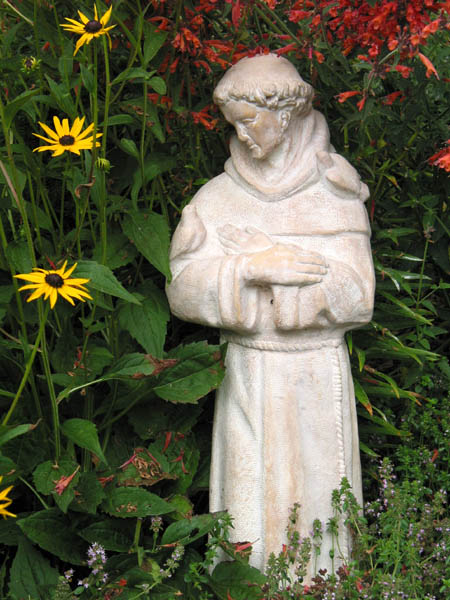
Which got me thinking. In the 13th century, the Church was suffering from corruption from within and the threat of Muslim invasion and secularism from without. Sound familiar? Until a young man named Francis had a dream that Jesus was telling him "rebuild my church." We think of him as a nice man in brown who holds birds in his hands, but in the day he was quite the radical. He walked hundreds of miles, barefoot, to preach to the Muslims, with the result that they did not invade.

It seems like the Church today is experiencing another "Seldon crisis." Will Jesus appear and help us through this one? Perhaps he already has...

Saturday, December 21, 2013

Yes, New Jersey, there is a Santa Claus

It seems for some people there is a controversy as to whether to tell their kids about Santa Claus. Some people get quite upset about how parents "lie" to their children about Santa. This baffles me. Of course there's a Santa Claus. As The Saint Nicholas Center explains, Santa Claus is another name for St. Nicholas, who was bishop of Myra. Over the years Saint Nicholas became "Sant Ni Klaus" which became "Santa Claus". He is the patron saint and protector of children, and known for his generosity and orthodoxy. And yes, he did punch a heretic at the Council of Nicaea. And anyone who says he doesn't exist is sadly mistaken.

This is what I have always taught and continue to teach my children. But realize there are three Santas we talk about.

First, there is the Santa I just mentioned, St. Nicholas, the "real" Santa. Of course he exists. His relics are on display in Italy. And yes, he's real. As real as all the saints with him in heaven. I suppose Protestants would have a problem with him being alive in heaven, but even they must admit he exists, even if "sleeping." But of course, as a Catholic I recognize that God is the God of the living, not the dead (Matthew 22:29-32).

Then there are the guys in the mall who have fake beards and say "Ho ho ho." Nobody believes they are really Santa Claus, they are just actors playing a twisted notion of Santa. In fact, as I explained to my kids from an early age, the "Coca Cola" Santa is not the real Santa. But if you want to call them Santa, yes, they exist. the proof can be found in any mall across the country.

Laslty there's the Santa that delivers presents in the middle of the night on Christmas Eve. Of course he exists. The proof is that there will be presents under the tree on Christmas morning. "But isn't Santa really your parents?" my youngest son asked me. Well, if so, then of course your parents exist, so that Santa Claus exists too.

So by any definition of "Santa Claus" he exists. As I see it, it is misinformation (at best) to tell your children Santa is a myth.

Tuesday, August 20, 2013

Only the good die young

Source: Wikipedia
If you haven't been living in a cave you've probably heard the Billy Joel song "Only the Good Die Young." It's a very catchy tune, and when it's on the radio or somewhere I can't help but hum along. But did you ever stop to listen to the words? It's pretty horrible. A man is trying to get a young girl (not sure how young, if you get my drift) to have sex with him. The girl is a virgin and he blames the Catholic Church for keeping her from having the fun that she should be having.

Aside from the anti-Catholic lines, there is one verse that catches my attention:
They say there's a heaven for those who will wait
Some say it's better but I say it ain't
I'd rather laugh with the sinners than cry with the saints
Sinners are much more fun

It catches my attention because many people think it's true. And even if you read the Butler's Lives of the Saints you get the same impression - that the saints live horrible lives in misery. But getting a martyr's death isn't the point of sainthood, or even a requirement.

Take a moment to watch this video about St. Maximilian Kolbe.


St.Kolbe died what to us would seem a horrible death, but he wasn't crying, he was smiling. I haven't been around too many saints, but I have been around lots of sinners, and although they have their moments of laughter, there's a lot of crying going on. It seems to me that Billy Joel's words are spoken out of ignorance, or maybe wishful thinking. You don't laugh with sinner and cry with saints, but more like the other way around.

The saints are the joyful, peaceful happy ones. This becomes evident if you read the writings of the saints, or see videos of them. There is a quality about real saints that makes you admire and want to be like them, which is quite opposed to the way they are portrayed in secular descriptions.

So I was thinking of a way to explain this to people by way of analogy. Let's say all you knew about exercise was watching a weight lifting competition. You might think "I don't ever want to exercise and become strong because strong people are just crushed with weights." Quite the opposite is true. The weak person struggles lifting weights, while the strong person is not bothered by them.

St. Maximilian Kolbe didn't die a hard death. He simply saw a weight too heavy for someone else, that he could lift with ease.

Wednesday, March 6, 2013

Upside down

Today I read about a NYT poll on Catholics' Views on Pope Benedict XVI and the Church. There is an accompanying article U.S. Catholics in Poll See a Church Out of Touch. Some bloggers see this as something bad (because Catholics are against Church teaching) others see it as "good" (that the Church isn't bending to conform to society). I see encouraging signs in this poll that I haven't seen anyone mention, however. Here they are. Note that this article takes the position that the glass is half full, so your mileage may vary.

If you look at the answers on what people thought of Pope Benedict XVI they are overall positive. Only 9% of people reported an unfavorable opinion of him (vs. 40% favorable and about half neutral). That's despite eight years of media (including and especially the NY Times) making false claims about his knowledge of and role in the sex abuse scandals. It speaks very well of Pope Benedict's ability to unite the flock and reach people even if they disagreed with him on a number of issues.

Only 12% thought the Pope had a negative influence on the Church (vs. 26% positive and about half neutral). That's despite his efforts to bring the ever popular "Vatican II" crowd back to sanity (i.e. his hermeneutic of continuity). Again this speaks to the ability of truth, spoken in love to reach people. While the Pope did not shy away from controversial issues, he never let the issue define his position but brought everything back to the love of Christ.

People think their priests and nuns are more like them than their bishops or the Pope. This is as it should be for several reasons. First off, you can't pick your Pope or bishop, but you can shop around for a parish priest who agrees with you. Secondly, you actually hear what your priest says, versus the bishops and Pope, who's words are either ignored or filtered through a hostile main stream media (when's the last time most people actually read an encyclical, or even visited their diocesan or Vatican web site to see the words are leaders are speaking?). So the results should not be discouraging.

58% of Catholics are following the Pope's resignation story closely. This is a tremendous opportunity for the Church to reach out and try to educate the world on what the real issue is about - the salvation of souls - as Dr. Gregory Popcak relates in “And the Gates of the NY Times Shall Not Prevail Against It.” (well worth reading).

Asked if they cared about the new Pope, 29% said "a great deal" (vs 7% "not at all" and the majority cared to some degree). Most respondents said they didn't care what part of the world the Pope came from - good for them! 37% thought the next Pope should be at least as conservative as Pope Benedict (18% wanted more a more conservative Pope) vs. 54% who wanted a more liberal Pope. I really though this would go more liberal than that. A 2:3 split isn't bad for someone whose teachings are 100% faithful to Christ's.

And then the whole thing went off the rails when they got into issues of dogma. But the point I bring away from this is that even for those who are against Church teaching, the issue is one of catechesis, not one of disengagement. There was a time when I thought the Church was just behind the times, and things like contraception were morally OK, and would someday be recognized as such when they Church caught up with technology.

I now realize what a fool I was because I learned. I learned that the Church exists not to follow us, but to follow Christ. I learned that the Pope doesn't make the rules, Christ does, and short of Him coming down and saying "ordain women", the Pope has no authority to change that teaching. The Pope's role is to teach with Christ's authority on Earth. If everybody on Earth decided that Christ's teachings were wrong, it would make everybody on Earth wrong - the teaching would not change.

The world, in its arrogance, expects that if they put economic pressure on the Church, or political pressure on the Church, she can be persuaded to change her stance to conform to it. History paints a different story. From the apostles onward Catholics have always been willing to die rather than change their views. That is what it means to be truly Catholic. The question is, will the world relent, or are we facing another wave of martyrdom? Signs point to the latter. If so, I pray I will have the strength to go cheerfully.

I can't help but consider the life of St. Maximilian Kolbe, who spent his life trying to educate, and in the end, gladly gave it up for the sake of the Gospel. It is said that while he and his fellow prisoners at Auschwitz were being executed by starvation for three weeks, he lead them in hymns of praise to God, until his voice was the only one left, and he was murdered by lethal injection. It is a gruesome tale, but one worth reading, because it ends in heaven. St. Kolbe ora pro nobis.

[I usually try to pick "clever" titles for this post, and don't explain them, but I thought some of the things I intended were obscure enough I would write about it. "Upside down" refers to my seeing an upside in an article that was intended to be a "downer" for the Church. It also refers to the way the respondents to the poll see the Church (as having policy driven from the mass of Catholics in the world rather than having policy defined by God). It refers to the way we try to take what is most high and bring it down to our level. Lastly, it refers to the martyrdom of St. peter, the first Pope, who when the world demanded that he change accepted death on a cross upside down.]

Saturday, October 16, 2010

Lorenzo Who?

If you haven't been in a mine yourself the last few days you must have heard about the rescue of the trapped miners in Chile. In several of the articles I read they spoke of the miners' deep Catholic faith as being the primary reason the miners came out of this situation as well as they did (obviously these stories were not in the main stream media, btu that's another post). The miners and their families had a devotion to San Lorenzo, the patron saint of miners. In fact, the rescue operation was dubbed "Operation San Lorenzo".

So who was this San Lorenzo? A search on patron saint of miners yields nothing about San Loenzo (other than links to articles about the Chilean miners). The most common Saint mentioned is St. Barbara, although SQPN lists several: Sts. Anne, Barbara, Eligius, Leonard of Noblac, Piran and Virgen of Rosario.

A search on San Lorenzo, or Saint Lawrence as he is known in English, and "miners" yields lots of links to articles on the Chilean miners, plus several mines and mining museums, which confirms that he is in some way associated with mining. Searching a little more, I found lots of information about the saint, but not about how he became the patron saint of miners.

So what is the image at the top of this post, and what does it have to do with St Lawrence? It is a picture of the Holy Grail. Now, before you laugh and start saying things like "What is your favorite color?" and "It's a flesh wound!" let me assure you this is no joke. The Holy Grail, which is the cup Christ used at the Last Supper, may just be this cup in Valencia Spain. As with all archeological artifacts we will never know with certainty, but many historians are convinced of the provenance of this one, and it turns out St. Lawrence is the one who got it to Spain.

The information below is taken mostly from the Saintcast episode St. Lawrence & the Holy Grail. The Saintcast is a great podcast about the saints by Dr. Paul Camarata. You can find it on iTunes. In this episode Dr. Camarata imparts an account of St. Lawrence written in the 6th century by St. Donato of Hippo, as published in the book "St. Laurence And The Holy Grail: The Holy Chalice Of Valencia" by Janice Bennett. The errors in this account are mine, as I hurriedly took notes while listening.

St. Lawrence was born in Huesca, in Spain, to parents Orencio and Paciencia. Lawrence's brother was ordained a priest, and Lawrence a deacon. When a Greek papal representative named Sixtus came through the region, Lawrence, 14 at the time, was impressed by his knowledge and piety and asked to accompany Sixtus back to Rome to learn from him. He did this, and became well known in Rome for his charity, visiting and tending to the poor and sick.

Rome in the 3rd century was not a good place to be a Christian. There were a series of persecutions throughout the Roman empire. Lawrence's parents were crucified on on May 3, 246, when Lawrence was 20. He persisted in his good works throughout the persecutions, visiting martyrs in jail and accompanying them through torture and seeing to their burial. He became the treasurer and chancellor of the Church.

In 253 the emperor Valerian came to power, who was more tolerant of Christianity than his predecessors. However, his views changed, and in 257 decreed that all priests and bishops should be forced to publicly sacrifice to the Roman gods or face death.

On August 2, 257 Pope St. Stephen I was beheaded while celebrating mass. Sixtus succeeded Stephen as Pope Sixtus II. Sixtus, anticipating that he would be arrested, entrusted all of the treasures of the church to Lawrence, including the Holy Grail and other relics. Shortly thereafter Sixtus was arrested. He was ordered to offer sacrifice to the Roman Gods but refused. Lawrence visited Sixtus in prison, who predicted Lawrence would also be arrested in three days.

Lawrence set about distributing the goods of the church which were in his care. Whatever he could, he sold and distributed to the poor. Relics, including the Holy Grail he gave to a fellow countryman of his, Precelius of Hippo. He asked him to bring them to the place of his birth to keep them safe from Valerian.

Sure enough, Sixtus was beheaded at the temple of Mars, and Lawrence was arrested. He was placed in the custody of a guard named Hippolytus. While in prison he baptized and healed a blind prisoner, Lucillus. Word got out and blind people from all over began to come to the jail to be healed. Even Hippolytus was converted and baptized.

When Valerian heard of this he ordered Lawrence to turn over to him all the treasures of the church. Lawrence asked for three days to gather the treasures. At the end of three days he came before Valerian with a group of poor, blind and lame people and declared that these are the eternal treasures of the church. Valerian had him tortured.

His torture went on for days, and the account is quite gruesome. He was beaten until the torturers became too tired to continue, and then again until the instruments they were using broke. He was placed on a rack until his limbs were dislocated. Sheet of metal were heated until glowing and pressed into his flesh. He calmly and happily praised God through it all.

During this his torturers saw a handsome young man next to him, speaking to him and wiping his brow. At least one of the torturers converted and was baptized by Lawrence. When Valerian saw that he was apparently calm and happy he ordered Lawrence to be put on a metal grating and slowly roasted over hot coals until dead.

It was after hours of this treatment that St. Lawrence made his oft quoted remark "turn me over, I am quite done on this side". He was turned over, eventually died, and was buried on August 10, 257. His head was later dug up and now resides in the Chapel of Matilda where it is displayed every year on August 10th. The head clearly shows the marks of his torturous death.

Saints.sqpn.org lists him as the patron saint of chefs (which makes sense given his last words) as well as dozens of other things. It doesn't mention miners. As I mentioned my best guess is that he is the patron saint of coal miners in particular, because of his death over a coal fire.