This is the second installment in a series of posts on the question of "when does human life begin?"
Part one of this series examined what science has to say about the matter. In this installment we discuss what religion (specifically Christianity) has to say about it.
When I started looking at this question I thought the answer was pretty cut and dried, but it turns out to have more twists and turns than I anticipated. I also wanted to write a broader perspective than just Christianity. But it turns out there are a lot of religions which have nothing to say on the matter, or which have no rational basis for any belief on the matter, so I'm sticking with what I know best, and has the most reasoned arguments, and also happens to be the largest religion in the world - Christianity. Plus, the topic is so large that I can barely cover Christian essentials in one post.
Scripture
We can find out some of our answer in Sacred Scripture. Many pro-life people use
Jeremiah 1:5 as supporting their position.
Before I formed you in the womb I knew you, before you were born I dedicated you, a prophet to the nations I appointed you.
While I think this is beautiful and poetic verse, I have to admit that it really doesn't say much about abortion. God, being outside time, knows all things at all times. So I could as accurately write "100 years before God formed me in the womb He knew me." Likewise,
Psalm 127:4-5
Like arrows in the hand of a warrior are the sons born in one’s youth. Blessed is the man who has filled his quiver with them.
Beautiful, and both speak of the value of human life, but not specifically about when human life begins. I think most pro-choice people would agree that human life is precious, but don't believe the unborn to be human life.
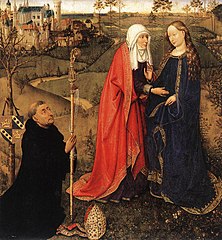
For "when does human life begin" I turn to
Luke 1:36-44 where we have the story of the Visitation:
And
behold, Elizabeth, your relative, has also conceived a son in her old
age, and this is the sixth month for her who was called barren; for
nothing will be impossible for God.” Mary said, “Behold, I am the
handmaid of the Lord. May it be done to me according to your word.” Then
the angel departed from her.
During
those days Mary set out and traveled to the hill country in haste to a
town of Judah, where she entered the house of Zechariah and greeted
Elizabeth. When Elizabeth heard Mary’s greeting, the infant leaped in
her womb, and Elizabeth, filled with the holy Spirit, cried out in a
loud voice and said, “Most blessed are you among women, and blessed is
the fruit of your womb. And how does this happen to me, that the mother
of my Lord should come to me? For at the moment the sound of your
greeting reached my ears, the infant in my womb leaped for joy.
Here
we see as soon as Jesus was
conceived, Mary finds out that Elizabeth is in her 6th month of pregnancy, she set out and traveled "in haste" to visit her . How long did it take to get there? We don't know exactly, but
it couldn't have been too long because we are told that Mary stayed
with Elizabeth for three months, and apparently wasn't present when John
the Baptist was born (Luke 1:56-57).
So at the time of
the visitation, Jesus would have been an embryo less than four weeks old
(prehaps less than a week old if the distance were short), and yet St.
John and Elizabeth both recognize Him as a person, their Lord. Therefore we
can show from Scripture that human life begins before the first four weeks after
conception, and possibly as early as conception.
Aquinas

In the ruling on Roe v. Wade Thomas Aquinas was quoted:
“It
is undisputed that at common law, abortion performed before
“quickening” – the first recognizable movement of the fetus in utero,
appearing usually from the 16th to the 18th week of pregnancy 20 – was
not an indictable offense. . . . [which] appears to have developed from a
confluence of earlier philosophical, theological, and civil and canon
law concepts of when life begins. . . . Christian theology and the canon
law came to fix the point of animation at 40 days for a male and 80
days for a female, a view that persisted until the 19th century, there
was otherwise little agreement about the precise time of formation or
animation. . . . Due to continued uncertainty about the precise time
when animation occurred, to the lack of any empirical basis for the
40-80-day view, and perhaps to Aquinas’ definition of movement as one of
the two first principles of life” (ROE v. WADE, 410 U.S. 113 (1973): IV.3)
I
find it amusing and ironic that the court would turn to this source
over and above scientific testimony to the contrary. This is also a
gross misrepresentation of Aquinas' view on abortion. Just look at
Summa Theologiae, IIa, IIae, q. 64, a 8
which deals with "Whether one is guilty of murder through killing
someone by chance?" Aquinas is actually expanding on the law as written
in
Exodus 21:22:
Reply
to Objection 2. He that strikes a woman with child does something
unlawful: wherefore if there results the death either of the woman or of
the animated fetus, he will not be excused from homicide, especially
seeing that death is the natural result of such a blow.
As
you can see by actually reading Aquinas, it is very hard, even with a
little context, to claim that St. Thomas did not consider intentional
abortion a crime, when he says even an accidental one is a crime.
As for ensoulment, Aquinas did have an opinion that perhaps the soul becomes human, rather than starts out as human form conception. However, his understanding of conception and fetal development is quite faulty, and so using Aquinas as an "authority" on this matter would be like using a heliocentric-believing philosopher as an authority on space travel. Here's what St. Thomas has to say in
Quaestiones Disputatae de Potentia Dei, q. 3 a. 9 ad 9 [comments mine]:
Reply to the Ninth Objection. There are several opinions about the life of the embryo. According to some in human generation the soul, like the human body, is subject to stages of progression, so that as the human body is virtually in the semen, yet has not actually the perfection of a human body by having distinct members, but gradually reaches this perfection through the force of the semen... Gregory of Nyssa mentions this opinion (De Homine): but it cannot be admitted... Hence we gather that the semen is animated potentially in that the soul is not therein. [in other words, semen has no soul]
[after a long discussion] We must therefore say differently that from the moment of its severance the semen contains not a soul but a soul power...According to this opinion the embryo before having a rational soul is a living being having a soul, which being set aside, a rational soul is induced... [what he is getting at is that the rational (or human) soul develops when the fetus becomes organized]
This is the most extensive writing on the subject, although Aquinas also talks about it in
Summa Theologiae I q. 118 a. 2 ad 2. This position at first glance seems similarto many modern pro-choice people, who say that the fetus is not "human" until it reaches some arbitrary point of development (we'll be looking at that in a future post), which is probably why he is referenced as if he were pro-choice. The question, of course, becomes "how much development is enough?" It could easily be argued that if Aquinas had access to a modern embryology textbook he would declare the soul present form the moment of conception, based on the organization present in the blastocyst itself. However, we have no way of knowing, because Aquinas never had such knowledge. And of course, as mentioned above, Aquinas did not excuse abortion, even at an earlier stage than he he considered necessary for a rational soul to exist.
The Catholic Church
Thomas Aquinas is a saint, and a
doctor of the Church, but that doesn't make him inerrant (as Sacred Scripture is) or even infallible (as the
Magisterium is). The Church does not define exactly when the soul enters the body, but does not condone abortion whether or not the fetus is ensouled. The Sacred Congregation for the Doctrine of the Faith issued a clarifying document on this,
Declaration on Procured Abortion, which states:
13. To this perpetual evidence - perfectly independent of the discussions on the moment of animation [aka ensoulment] - modern genetic science brings valuable confirmation. It has demonstrated that, from the first instant, there is established the program of what this living being will be: a man, this individual man with his characteristic aspects already well determined. Right from fertilization is begun the adventure of a human life, and each of its capacities requires time- a rather lengthy time- to find its place and to be in a position to act. The least that can be said is that present science, in its most evolved state, does not give any substantial support to those who defend abortion. Moreover, it is not up to biological sciences to make a definitive judgment on questions which are properly philosophical and moral such as the moment when a human person is constituted or the legitimacy of abortion. From a moral point of view this is certain: even if a doubt existed concerning whether the fruit of conception is already a human person, it is objectively a grave sin to dare to risk murder. "The one who will be a man is already one."
19. This declaration expressly leaves aside the question of the
moment when the spiritual soul is infused. There is not a unanimous tradition on
this point and authors are as yet in disagreement. For some it dates from the
first instant; for others it could not at least precede nidation. It is not
within the competence of science to decide between these views, because the
existence of an immortal soul is not a question in its field. It is a
philosophical problem from which our moral affirmation remains independent for
two reasons: (1) supposing a belated animation, there is still nothing less than
a human life, preparing for and calling for a soul in which the nature received
from parents is completed, (2) on the other hand, it suffices that this presence
of the soul be probable (and one can never prove the contrary) in order that the
taking of life involve accepting the risk of killing a man, not only waiting
for, but already in possession of his soul.
In other words, since can't prove there is a time from conception where there isn't a human soul present we must assume there might be, and act as if there were. To do otherwise is to admit that murder is OK, which it is not. I'll be returning to this philosophical argument later as well.
Sorry for the long post, but you can see why I broke this into installments. There is a wealth of information. I encourage you to follow the links in this post and read the original documents. You may find it hard to follow Thomas' arguments due to the difference in terminology and langauge, but the rest of the links should be an easy, if lengthy, read.








 Posts
Posts

